“Prediction is not about the future. It’s about understanding the present so well that the future becomes inevitable.” – George Box, Statistician
Business success today isn’t just about reacting quickly. It’s about preparing proactively. That preparation starts with making better use of your data, not just analyzing what happened but understanding what’s likely to happen next.
That’s exactly what the predictive analytics software is built for. And it’s not just enterprise giants using them in 2026. Mid-size businesses, SaaS platforms, healthcare providers, fintech startups, and logistics firms are leaning increasingly more on AI-driven analytics tools that can predict demand, identify customer trends, or alert a company about risks before they become problems.
This guide will teach you what predictive analytics is really all about in terms of your business, which tools are shining today and how to weigh out the best fit for your team’s particular goals.
Understanding Predictive Analytics in Practical Terms
Let’s skip the technical jargon. Predictive analytics is about using your historical data and current activity to make smart guesses about what’s coming next.
You already do this, informally. A sales manager noticing a dip in engagement might forecast a bad quarter. A warehouse supervisor might order more stock based on gut feel. Predictive analytics solutions puts math and machine learning behind those instincts, and makes them more accurate.
It answers questions like:
- Which of your customers is likely to churn next month?
- What kind of support requests will spike during your next product launch?
- How many new hires will you need based on growth trends?
These aren’t simple guesses, they’re forecasts backed by patterns your data has already seen, but you may have missed.
Predictive Analytics Is No Longer Optional…!
89% of high-growth companies already leverage it to predict customer behavior, cut risks, and accelerate revenue.
How Predictive Models Actually Work
Most predictive analytics tools may seem like black boxes but the fundamentals are surprisingly logical. At their core, these models take in your historical and real-time data, search for patterns and map those patterns to future events.
Think of it the way a simple regression model would forecast next quarter’s sales by drawing on the previous numbers and the year’s seasonal trend. A decision tree can identify which traits a customer has that make her likely to purchase again. And, a time series model predicts inventory requirements from past usage levels. These analytical approaches showcase how business decision making with data science enables organizations to move beyond guesswork and make more accurate, data-driven strategies.
As tools advance, you’ll also see more sophisticated models like random forests, gradient boosting machines, or neural networks. These technologies can serve as the ultimate prediction tool for improving accuracy, especially when dealing with larger, noisier data sets. You don’t necessarily have to understand the algorithms in depth, but knowing they are available helps you ask better questions and select the right tool for the job.
Why More Businesses Are Investing in Predictive Tools in 2026
Companies that use predictive insights are twice as likely to outperform their industry peers on key financial metrics. That’s not a coincidence. In an unpredictable market, the ability to see around corners is a major advantage.
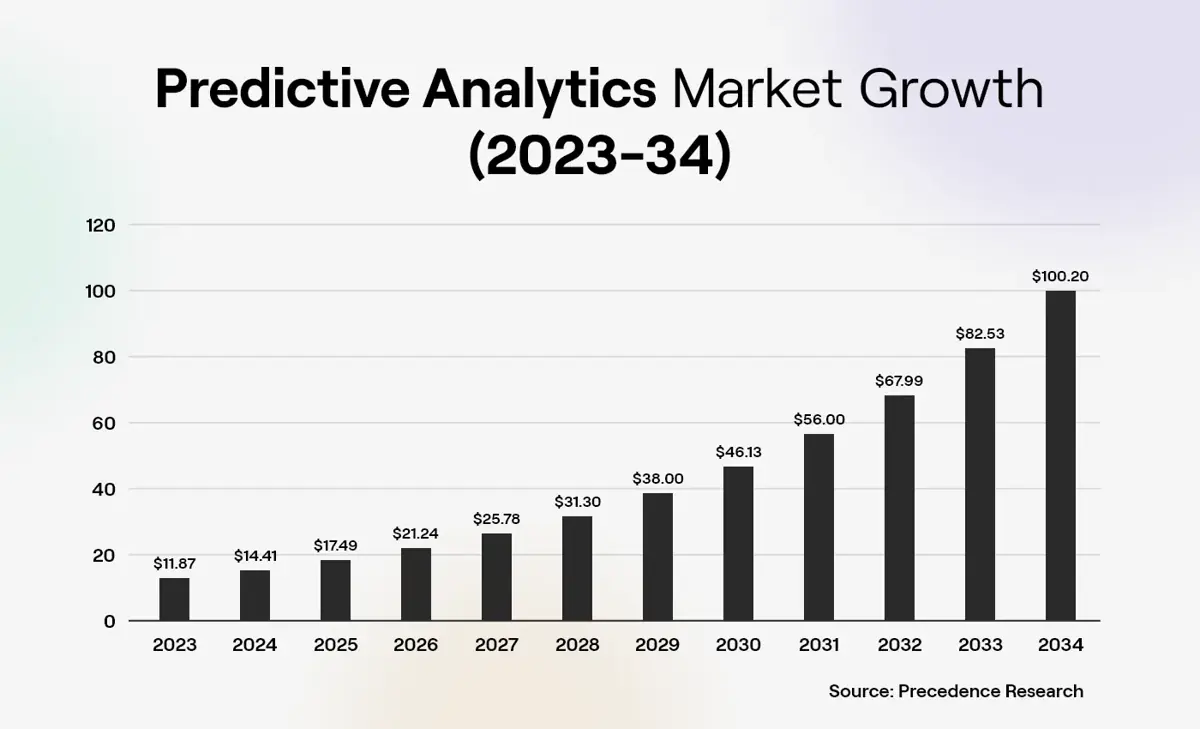
Here’s why adoption is accelerating:
- Data is finally centralized. With cloud data warehouses like Snowflake and BigQuery, companies have easier access to clean, unified data.
- ML tools are easier to use. Platforms now offer drag-and-drop interfaces and automated model generation. You don’t need a PhD in data science.
- Budgets are shifting toward insight. Companies are moving away from reports that show what already happened, and investing in tools that tell them what to do next.
In other words, leaders are tired of reactive planning. They want foresight, not just hindsight (observation).
Real Business Impact: Predictive Analytics at Work
Let’s look at some real examples of how companies are applying predictive analytics for business today:
- A midsize logistics company reduced delivery delays by 18 percent during peak seasons; thanks to demand forecasting.
- A healthtech startup forecasted patient appointment no-shows, which enabled clinics to overbook and increase clinic revenue.
- A fintech app used predictive churn models to create retention offers that improved customer lifetime value by 22%.
These aren’t hypothetical use cases. They’re practical outcomes from companies that embraced prediction as part of their strategy.
Read more: How to Modernize Legacy Systems with AI – A Step-by-Step Guide
Key Features to Look for in Predictive Analytics Software
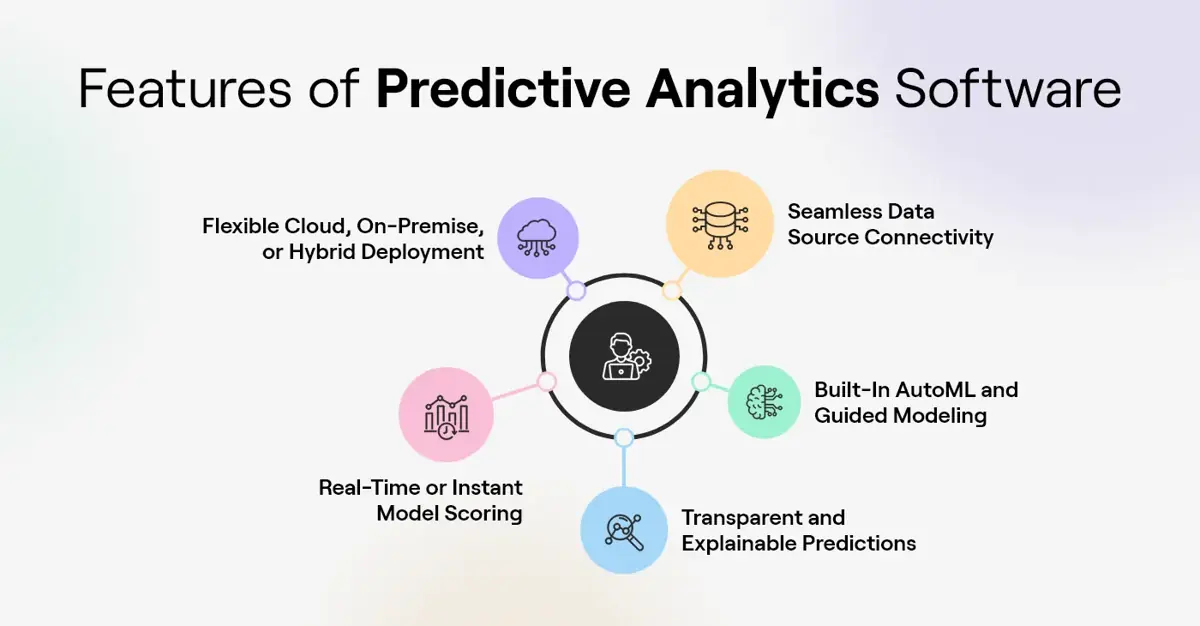
When choosing among the many predictive analytics platforms available today, here’s what to prioritize:
1. Data Integration
The tool should connect easily to your data stacks such as spreadsheets, CRMs, databases, APIs.
2. AutoML or Assisted Modeling
You want machine learning capabilities, even if you’re not hiring a team of data scientists.
3. Clear Explanations
Predictions should be accompanied by explanations, not just scores, especially in regulated industries.
4. Real-Time Scoring
If it takes an hour to run a model, you’re not making decisions fast enough. Look for tools with real-time or near-real-time performance.
5. Flexibility in Deployment
Cloud, on-premise, or hybrid models are available for deployment. Choose what fits your infrastructure and scales effortlessly with future business demands.
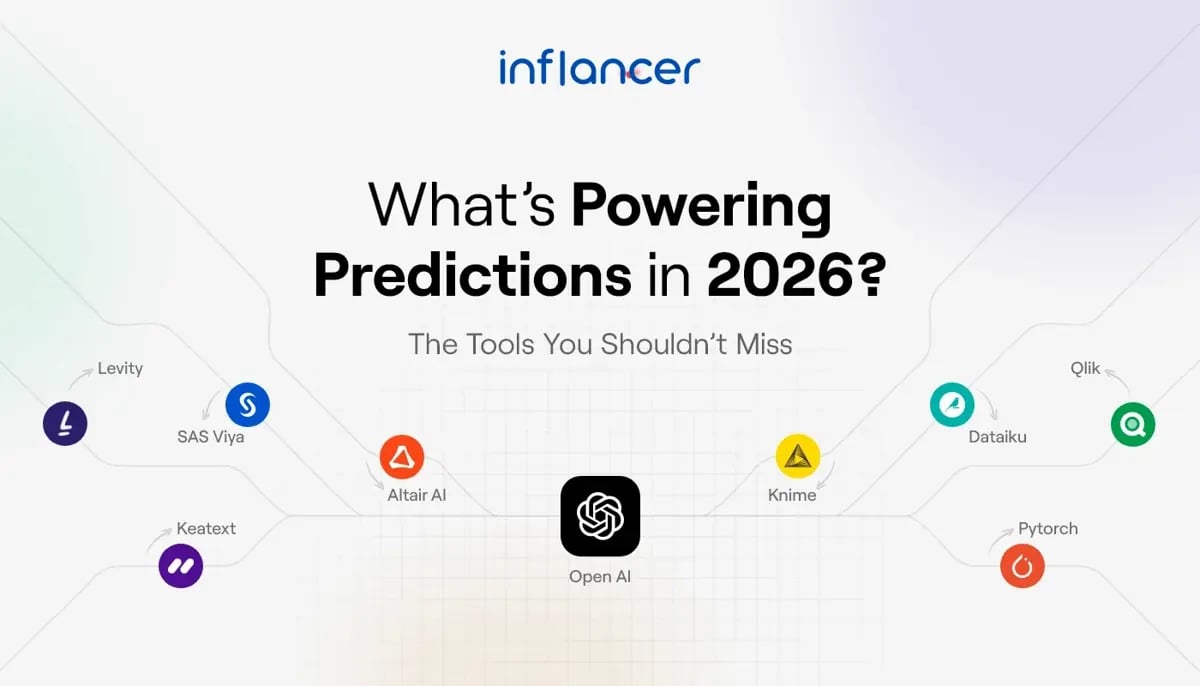
Top Predictive Analytics Tools to Know in 2026
Selecting the right predictive analytics software can feel overwhelming but you don’t need to worry. We’ve broken down the top predictive modeling tools that business teams can rely on in 2026.
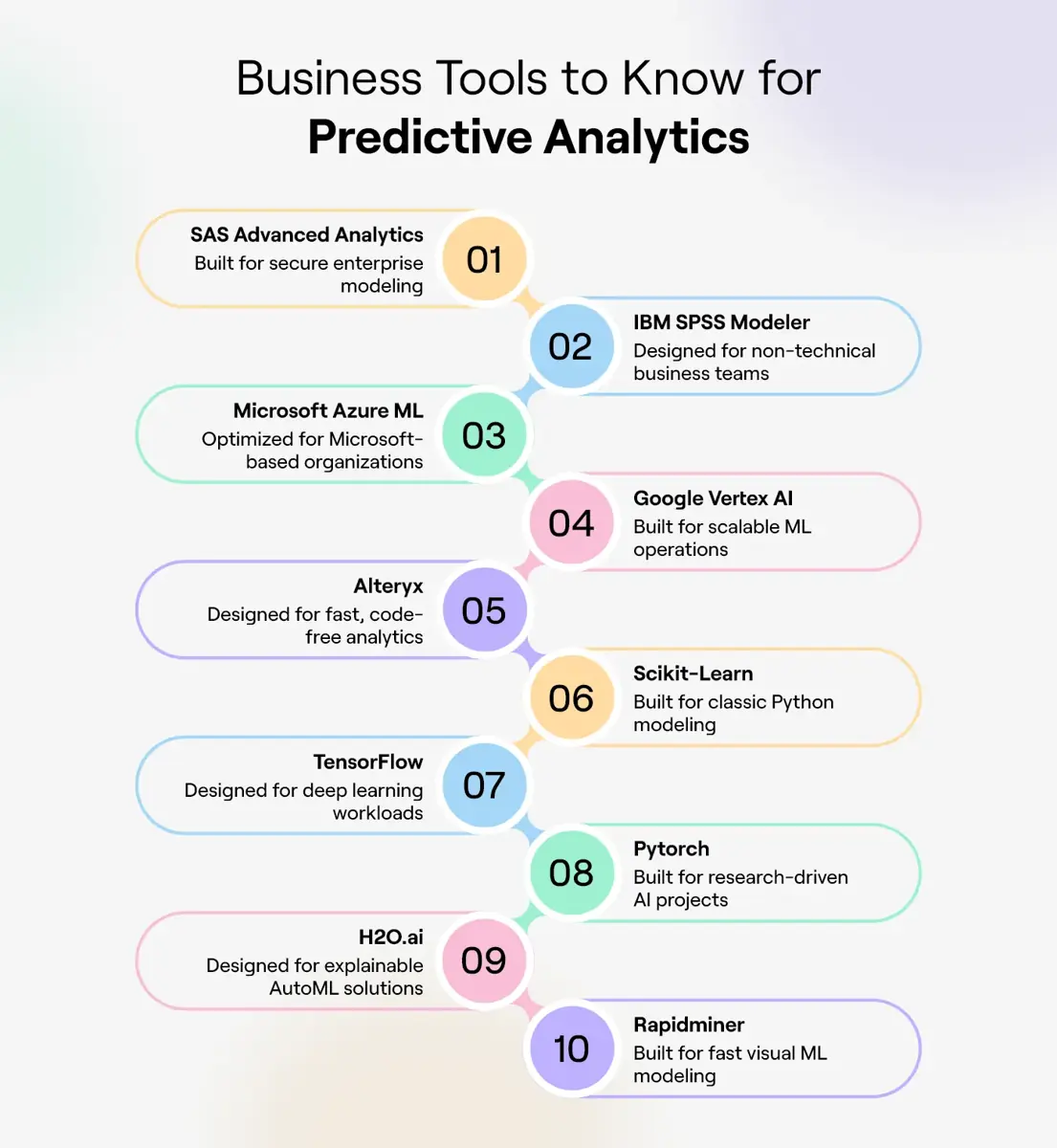
1. SAS Advanced Analytics
A secure, enterprise-grade platform delivering powerful statistical calculations for statistical analysis and compliance-ready reporting, and secure data handling. Highly recommended for regulated environments like banking, insurance and healthcare solutions, where accuracy and governance are not flexible!
2. IBM SPSS Modeler
Designed for business users, SPSS Modeler enables predictive workflows through an intuitive drag-and-drop interface. It’s a strong choice for marketing, HR, and operations teams seeking forecasting capabilities without the technical complexity of the best predictive analytics software.
3. Microsoft Azure Machine Learning
Build for companies already invested inside Microsoft’s universe, Azure ML integrates with Excel, Power BI, and Azure Data Lake right out of the box. It enables fast model deployment as well as end-to-end MLOps on a secure, cloud native infrastructure.
4. Google Vertex AI
Vertex AI offers scalability and flexibility, bringing together AutoML and powerful custom model development tools to support organizations with varying levels of technical expertise. Its capabilities also make it a strong choice for businesses exploring predictive analytics software tools while adapting to evolving AI strategies on Google Cloud.
5. Alteryx
Fast, simple, no code analytics platform. With little to no training, non-technical teams can prepare data, run models, and output insights in 1/5th the time compared to custom solutions in the market today, making it the go-to for digital marketing operation, finance and customer success teams.
6. Scikit-learn
Popular Python library for naive classification, regression, and clustering tasks. It’s a great fit for technical teams doing Python development to create fast, interpretable models with structured data.
7. TensorFlow
TensorFlow Google’s open source AI framework TensorFlow is built for production AI workloads. Ideal for AI development services and deployments with computer vision, NLP, and custom NNs on multiple datasets.
8. PyTorch
It is a favorite tool among researchers and structured product teams due to its dynamic graphing capabilities and flexibility, which allows faster prototyping. It’s being used more and more for real-time AI features, for more advanced experimentation and for academics moving into production.
9. H2O.ai
An open-source AutoML platform with model explainability, scalability, and enterprise readiness. H2O. ai It is a great option for companies who are looking for high-accuracy models with fairness, transparency and regulatory compliance in mind.
10. RapidMiner
RapidMiner provides data preparation, machine learning, and model deployment on a single platform. It’s built for business analysts and data scientists who want to create visual workflows with strong automation and enterprise integration capabilities.
Tool Comparison: Making the Right Choice
| Tool | Ease of Use | Best For | Strengths | Limitations |
|---|---|---|---|---|
| SAS Analytics | Rated 3 Star Out of 5 | Enterprises | Security, scalability | Steeper learning curve |
| IBM SPSS Modeler | Rated 4 Star Out of 5 | Non-technical teams | Visual interface, reliability | Limited deep learning |
| Google Vertex AI | Rated 3 Star Out of 5 | Data science teams | AutoML, cloud-native | Requires GCP ecosystem |
| Azure ML | Rated 4 Star Out of 5 | Microsoft environments | Seamless integration | Locked into Azure infra |
| Alteryx | Rated 5 Star Out of 5 | Analysts | Drag-and-drop simplicity | Pricing may be a barrier |
| H2O.ai | Rated 3 Star Out of 5 | R&D teams & startups | Open source, explainability | Needs more setup |
Trends You Cannot Ignore in 2026
Looking forward, several key changes are shaping the data analytics software 2026 landscape:
1. Smarter AutoML
Tools whereby models can select and tune themselves without human involvement are improving.
2. Predictive & Prescriptive
The best is not just predictive but prescriptive: They don’t just tell you what will happen; they suggest what to do about it.
3. Embedded AI
A growing number of tools are plugging into your apps, dashboards and workflows.
4. Privacy-Conscious Modeling
With laws like GDPR and HIPAA, explainability and privacy are more important than ever.
The Future Isn’t Coming, It’s Already Here.
From AutoML to embedded AI and privacy-first modeling, 2026 belongs to businesses that adapt fast. These trends aren’t just predictions, they’re the new baseline. Don’t just watch the shift. Lead it.
Predictive Analytics by Industry: A Quick Snapshot
Let’s get specific. Predictive analytics looks different in every industry. Here’s a snapshot of where it’s making waves:
Healthcare
Forecast no-shows, predict readmissions, optimize staffing based on demand patterns.
Retail & E-Commerce
Anticipate demand shifts, personalize product recommendations, forecast inventory needs.
Logistics & Supply Chain
Optimize route planning, predict delays, balance warehousing based on expected volumes.
Fintech
Spot potential fraud, predict credit risk, personalize customer financial journeys.
SaaS & Digital Products
Forecast churn, optimize feature rollouts, prioritize high-value users.
Wherever data flows, predictive analytics follows.
Related reading: Top AI Features to Integrate into Your Next App
How Inflancer Can Help You Get Started
At Inflancer, we specialize in helping businesses go from static dashboards to dynamic decision-making. Whether you’re building something from scratch or scaling an existing system, we bring:
- Strategic consulting on high-impact predictive use cases.
- Technical knowledge of frameworks like TensorFlow, scikit-learn.
- Easy integration with your cloud, CRM, or legacy systems.
We’re not here to sell you software. We’re here to help ensure it works for your business. Curious to experiment with predictive analytics alongside a live collaborator? Let’s build something that works.
Final Takeaway
In business, timing matters. Predictive analytics helps you act at the right moment, not too early, not too late. And with the tools now more accessible than ever, there’s no reason to leave that advantage on the table. Get the solution from Inflancer which is among the most reliable AI solutions in UK and various other demographics.
So, choose wisely. Start small. Scale smart. And make your data work as hard as your team does.
Turn Data into Decisions! Start Your Predictive Journey with Inflancer.
Frequently Asked Questions
Get the weekly updates on the newest brand stories, business models and technology right in your inbox.