
Reserve bus, hiace and sumo seats across Nepal without the queue.
Mero Ticket is Nepal's digital bus ticket reservation service. It connects travellers with verified bus, hiace and sumo operators across the country, with transparent pricing, e-tickets on the phone and tools for operators to manage their bookings.
- Industry
- Travel and transport
- Platforms
- iOS, Android, Web
- Market
- Nepal
Overview
The Mero Ticket story
Travelling between towns in Nepal by road is part of everyday life, whether it is heading home for a festival, travelling for work or exploring the country. Booking those journeys has traditionally meant visiting a counter, calling an operator or relying on a middleman. Mero Ticket moves that experience onto a phone: travellers find a route, choose a vehicle and book a seat with a few taps, and receive their ticket digitally.
The platform connects two groups who both benefit from digitisation. For passengers, it removes queues, uncertainty and hidden costs. For operators, it replaces handwritten registers and phone calls with a clear system for managing bookings and reaching more customers. The stated mission is to simplify travel in Nepal with a digital-first booking experience, and to build trust between passengers and transport providers.
We worked on the complete product: the passenger apps and web experience, and the tooling that allows operators to manage vehicles, routes and bookings. A ticketing platform has to be dependable in a very specific way. A seat sold twice, or a ticket that does not appear, damages trust immediately. So much of our work went into making the booking flow predictable and the data behind it consistent.
The longer-term vision is bigger than a single app: a trusted travel booking platform that connects every city, town and village through smart technology and reliable transportation. That ambition shaped our decisions. We chose clean data models, a design language that works for first-time users, and an architecture that can accommodate new routes, new vehicle types and new operators as the platform grows.
It is worth remembering who this product serves. A traveller heading to a village for a festival, a student returning to college and a family travelling together have different needs, but they share a wish for certainty. They want to know that the seat exists, the price is fair and the ticket will work. Every design choice in the product returns to that shared wish for certainty.
The challenge
What had to be solved
The first challenge was trust. Passengers are used to paying at the counter and holding a paper ticket. Moving to an app means asking them to pay first and trust that a seat will be waiting. The experience had to be reassuring at every step, with clear confirmations, readable e-tickets and a visible path to support.
The second challenge was inventory accuracy. Every vehicle has a fixed number of seats, and many people may try to book the same route at the same time. The system had to ensure that a seat is held while a traveller completes payment, released if they do not and never sold twice, even when many bookings arrive at once.
The third challenge was operator adoption. Transport providers range from large companies to small operators, and many were used to running their business on paper and phone calls. The tooling had to be simple enough to adopt quickly, valuable enough to be worth the change and flexible enough to match how real operators manage vehicles and schedules.
The fourth challenge was coverage and variety. Buses, hiaces and sumos behave differently: a long-route bus has an assigned seat layout, a hiace is smaller and faster, and a sumo is often shared. The product had to treat them as one coherent service while respecting the details of each, so that travellers can compare options easily.
Project goals
- Let travellers find routes and book seats from their phone.
- Cover buses, hiaces and sumos in one booking experience.
- Work only with verified, licensed operators.
- Show transparent prices with no hidden charges.
- Deliver e-tickets and keep bookings in the app.
- Give operators digital tools to manage bookings and grow.
The mobile experience
A complete journey, screen by screen
Finding a route in seconds
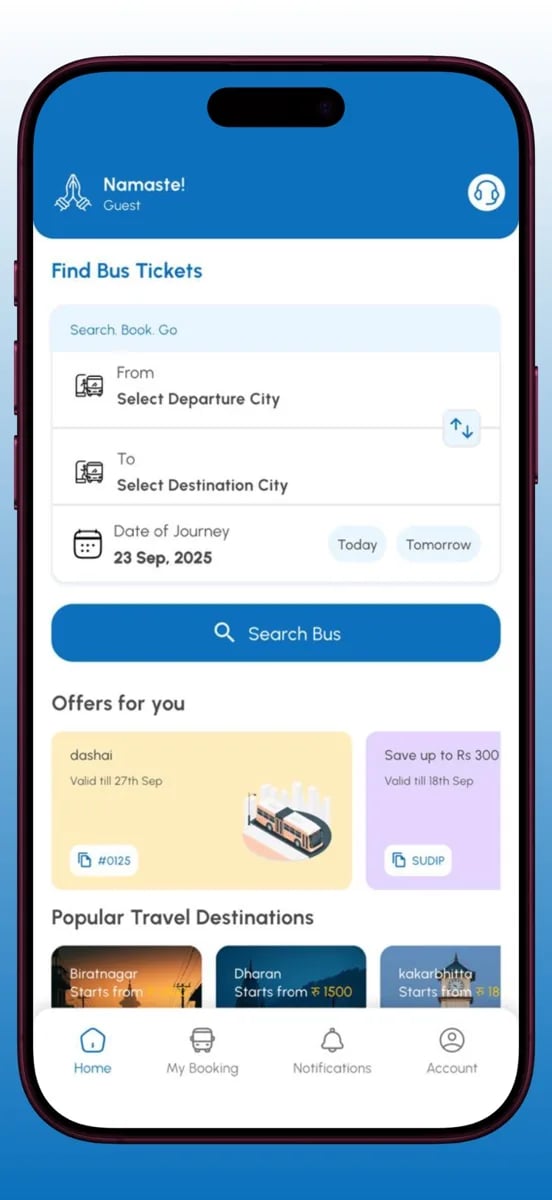
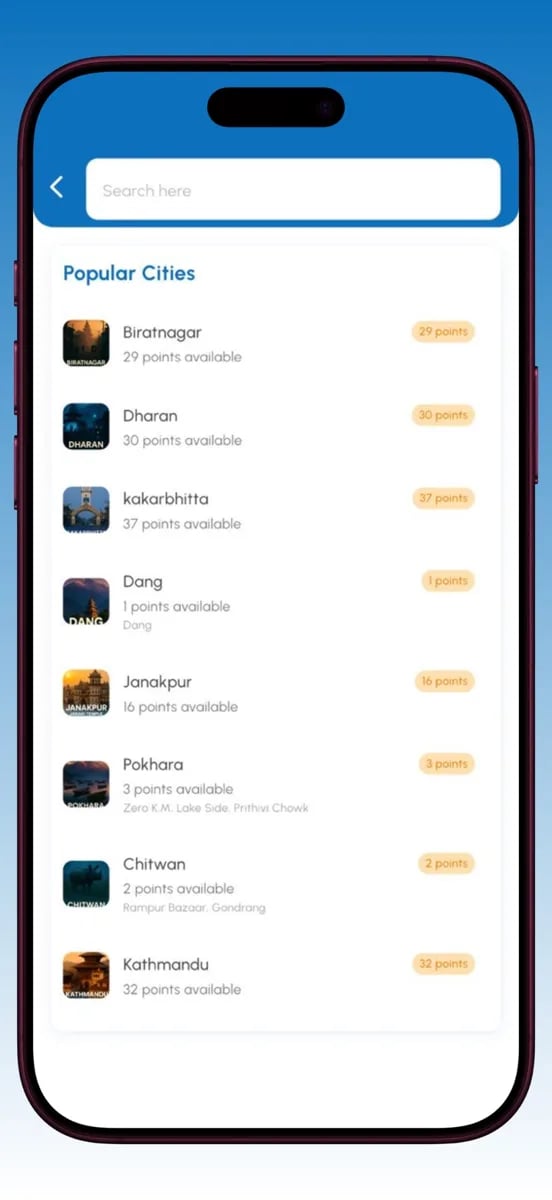
The first screen asks the obvious questions: where are you travelling from, where are you going and when. Towns are easy to pick, popular routes are suggested and the date selection is built for real planning. A traveller who knows their destination can have options on screen almost immediately.
Because many travellers repeat the same journeys, recent searches and common routes are one tap away. Someone heading home every month does not need to retype the same details every time.
The result is a search that feels as simple as telling a friend where you are going. The product does the work of finding the right vehicles, and the traveller stays in control of the choice.
- Simple origin and destination
- Popular and recent routes
- Easy date picking
- Fast repeat journeys
Comparing vehicles and operators
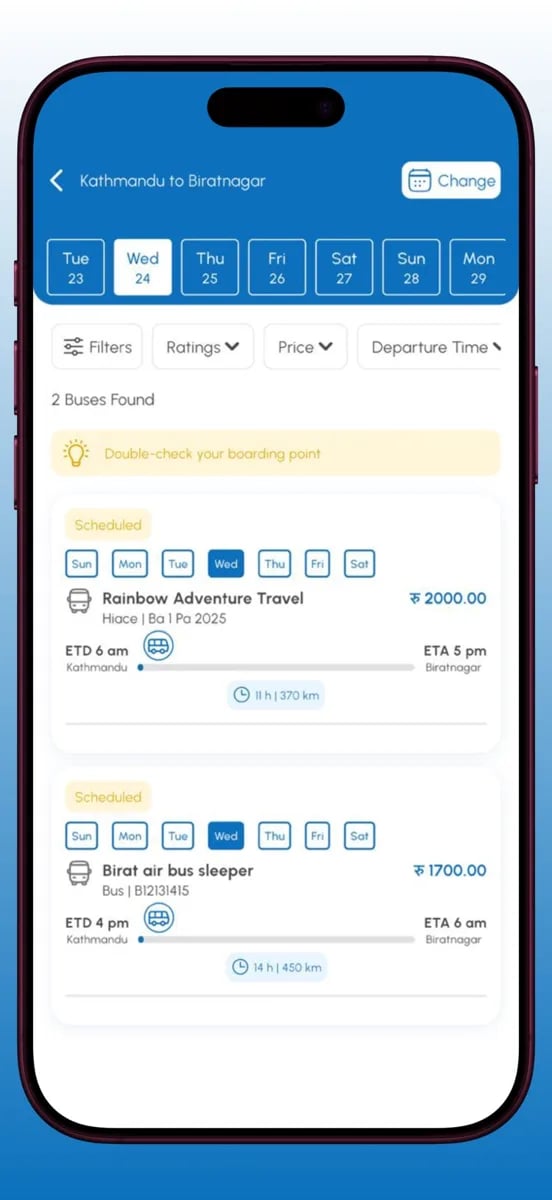
Results show the options available on the route: operator, vehicle type, departure time, duration and price. Buses, hiaces and sumos are clearly distinguished so that travellers can choose according to comfort, speed and budget.
Operators appear with their names and the information that helps people decide. Because the platform works only with verified providers, the list is a trusted set of choices rather than an unfiltered one.
Filters and sorting help people who care about specific things, such as an early departure or a particular type of vehicle, without making the screen complicated for people who just want the next available option.
- Operator and vehicle type
- Times, duration and price
- Verified operators only
- Filters and sorting
Choosing a seat with confidence
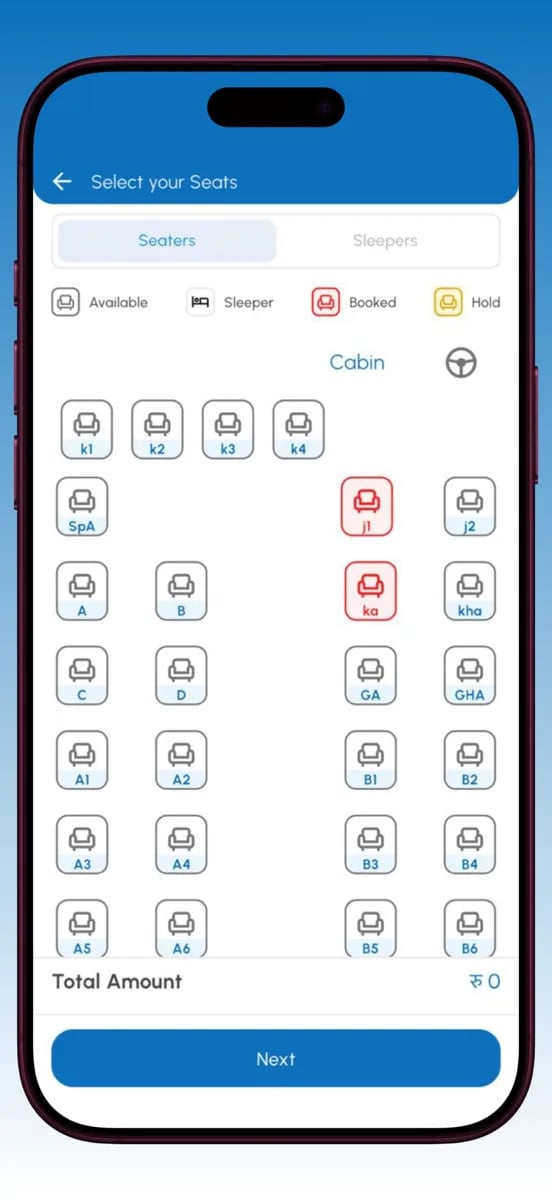
Once a vehicle is chosen, the traveller selects the seats they want. The seat selection is presented clearly, with available and taken seats easy to tell apart, and the number of seats and the total price always visible.
Behind the screen, the system holds the chosen seats while the traveller completes the booking, so that nobody else can take them mid-payment. If time runs out, the seats are released and the traveller is told plainly, instead of discovering the problem at the end.
This is a small interaction with large consequences. When it works, the traveller feels in control. When it does not, they feel cheated, so it received a great deal of attention in design and testing.
- Clear seat availability
- Running price total
- Seats held during payment
- Plain release messages
Passenger details and payment
The booking step collects what is needed for the journey and no more: passenger names, contact details and any boarding information. Fields are short and validated, and returning travellers can reuse their details.
Payment is presented as a calm, final step. The total is shown in full, the options are familiar and the traveller always knows what they are about to pay. Transparent pricing is one of the stated promises of the service, and the checkout is where that promise is kept.
On completion, the confirmation appears instantly with the key details of the trip. The traveller does not have to wait or wonder whether the booking has worked.
- Short, validated forms
- Full price shown
- Familiar payment options
- Instant confirmation
A ticket that lives on the phone
After booking, the ticket is available in the app as an e-ticket with the route, date, time, seats and operator. Travellers no longer need to keep a paper slip safe or worry about losing it before departure.
The ticket screen is designed to be shown at boarding. The important details are large, the layout is clean and it works in low light and on small screens, because that is where tickets are usually checked.
Past and upcoming tickets are listed together in the trips area, so a traveller can find any booking quickly, whether they are about to board or want to remember a journey from last month.
- Digital ticket with all details
- Designed for boarding
- Upcoming and past trips
- Always available in the app
A booking tool for transport providers
Operators are the other half of the platform, so the tooling built for them matters as much as the passenger app. They can manage their vehicles, routes and departure times, see bookings as they arrive and keep track of seat availability in real time.
For many operators this replaces handwritten registers and phone calls with something clearer and faster. It reduces double bookings, makes it easy to see how full each departure is and helps them plan their schedules with more confidence.
Digitisation also opens a larger market. Passengers can discover and book with operators they might never have found otherwise, which helps good operators grow, and helps travellers find reliable ones.
- Vehicle and route management
- Real-time seat availability
- Booking overview
- Wider customer reach
Help with changes and questions
Plans change, and the service is designed to help when they do. Travellers can reach support for bookings, cancellations or questions, and the information needed to resolve an issue is available to the team.
Clear booking records and statuses make it possible to answer quickly and accurately. That reduces the frustration of long exchanges and builds confidence in booking online rather than at the counter.
The same foundation supports future improvements such as reminders before departure, notifications about schedule changes and easier handling of cancellations, which can be introduced as the platform matures.
- Support for changes
- Clear booking records
- Notifications
- Room for reminders
Why Mero Ticket
What the product gets right
No more ticket queues
Travellers book seats from their phone instead of standing in line at a counter.
Buses, hiaces and sumos
The common ways of travelling between Nepal's towns are all in one app.
Verified operators
Travellers book with licensed operators, which makes journeys feel safer.
Transparent pricing
What the traveller sees is what they pay, with no hidden charges.
E-tickets on the phone
Booking confirmation is delivered digitally and kept in the app.
Routes across the country
Major routes between cities, such as Kathmandu to Pokhara, are covered by the platform.
A tool for operators
Transport providers manage seats and bookings digitally and reach more customers.
Support when it is needed
Help with bookings, cancellations and questions is part of the service.
Scope
What a product like this covers
Route search
Origin, destination and date, with popular cities, boarding points and offers.
Bus, hiace and sumo listings
Vehicle types presented clearly so travellers can choose.
Verified operators
Only licensed operators appear on the platform.
Seat selection
A seat map showing seater, sleeper, booked and held seats, with a running total.
Seat holding
Seats held during checkout and released if payment is not completed.
Transparent pricing
The full price shown at every step with no hidden charges.
Passenger details
Short, validated forms with remembered information.
E-tickets
Digital tickets kept in the app and designed for boarding.
Trips and history
Upcoming and past bookings listed in one place.
Operator tools
Vehicle, route and booking management for transport providers.
Support
A clear way to get help with bookings and cancellations.
Admin and reporting
Tools for the team to monitor bookings, operators and performance.
Engineering
The decisions behind the build
Seat inventory as the core
Seats are modelled carefully per vehicle and departure, with locking so that the same seat can never be sold twice, even under heavy load.
Holds and releases
A seat is held while a traveller pays and released automatically if they do not finish, keeping inventory accurate without manual work.
A model for different vehicles
Buses, hiaces and sumos share one booking model with vehicle-specific details, which keeps the system simple and extensible.
Operator onboarding and verification
Operators are verified before they appear, and the tooling lets them manage their own schedules and vehicles.
Reliable confirmations
Tickets and confirmations are generated and delivered reliably so that a paid booking always produces a ticket.
One platform, many surfaces
Passenger apps, the web and the operator tools share one backend, so every party sees the same truth about a booking.
Designed for busy periods
Festival seasons and holidays create sharp spikes in demand. The booking and inventory systems are built to stay accurate and responsive during those peaks, because that is when travellers need them most.
Who uses it
Built for every side of the product
Passengers
People travelling between towns for family, work or leisure. They want a quick booking, a fair price and a ticket they can rely on.
Operators
Bus, hiace and sumo providers. They need a simple way to manage seats and bookings and to reach more customers.
Support team
The people who help with changes and questions. They need clear booking records so they can respond quickly.
Platform administrators
The team behind Mero Ticket. They need to verify operators, monitor bookings and manage the platform as it grows.
Design principles
The rules we designed by
Never sell a seat twice
Trust in a ticketing product is built on one promise: if you have a ticket, you have a seat. We designed inventory and checkout so that promise holds under busy conditions, and treated any threat to it as the highest priority.
Show the whole price
Hidden charges destroy confidence. The total is visible from the first result to the final screen, which keeps the transparent-pricing promise throughout the journey.
Make it work for first-time users
Many travellers will use a booking app for the first time on this platform. We used clear language, familiar patterns and generous reassurance, so that nobody feels lost.
Respect the operator's way of working
Operators are partners, not an afterthought. The tooling adapts to how they already manage vehicles and schedules, so adopting it feels like an upgrade rather than a disruption.
Design for the bus stop
Tickets are often checked in crowded places with weak signals and small screens. We made sure that tickets are readable, available offline in the app where possible and quick to show.
Build for the national picture
The vision is a platform that connects every city, town and village. We chose structures and workflows that can scale to many more routes and operators without being rebuilt.
Process
From brief to live release
- 1
Learn the journey
We start by understanding how people currently book road travel and how operators manage seats, so the product improves on real habits.
- 2
Design passenger and operator flows
We design both sides together, since every passenger action has an operator-side consequence, and prototype them for review.
- 3
Build the inventory core
Seat inventory, holds and booking confirmation come first, because everything else depends on them being right.
- 4
Build apps and tools
The passenger apps, web experience and operator tools are developed in short sprints with a working build to review each time.
- 5
Test under pressure
We simulate busy booking periods and awkward cases such as expired holds and failed payments, to prove that inventory stays accurate.
- 6
Launch with operators
We support onboarding of the first operators, watch real bookings closely and keep improving the experience as coverage grows.
Screens
Mero Ticket app screenshots
Find bus tickets
Popular cities
Search results
Select your seats
Quality and trust
How we keep it reliable
Inventory integrity tests
We test concurrent bookings to confirm that seats are never double-sold and that holds and releases behave correctly.
Payment and ticket checks
Every paid booking must produce a ticket. We test that path, including failures and retries, thoroughly.
Usability with real people
Passenger and operator flows are tried with real users, so that they can be learned quickly.
Data protection
Passenger information is collected minimally and protected, and shown only to those who need it.
Performance on the go
Screens are light and quick, which matters on modest phones and uncertain mobile data.
Monitoring
Booking funnels and errors are tracked after launch, so problems with routes, operators or payments are found quickly.
“Dashain time, everyone is fighting for a bus seat. Last year people booked from home and just showed up. Some bus operators were against the app at first, they said 'who will use this'. Now they call me asking to be added.”
Cewan Giri
Founder, Mero Ticket
Looking back
What this project taught us
Mero Ticket shows how much value there is in taking an everyday transaction and making it dependable. The product does not need to be exotic. It needs to make a seat easy to find, easy to book and certain to be there when the traveller arrives. Achieving that certainty, on both sides of the platform, is the real work.
It also reminded us that a marketplace depends on its supply as much as its demand. Operators who find the tooling genuinely useful bring more routes, better schedules and more reliable service, which in turn brings more passengers. That is why we gave the operator side as much design attention as the passenger side.
If you are planning a ticketing, reservation or transport platform, we would be glad to talk through how to shape both sides of the marketplace, and how to build inventory and checkout so that they stay accurate as you grow.
A last observation is that digital ticketing quietly improves safety and organisation on the road. When bookings are recorded and operators are verified, there is a clearer picture of who is travelling and with whom. That is a benefit beyond convenience, and one reason the platform's goal of making road travel safer and more organised matters so much.
About the Mero Ticket project
Straight answers about how a product like this is planned, built and launched.
Still exploring? Let us help.
A small senior team, a developer assigned within 48 hours, and source code that is yours on full payment.
“Simple. Fast. My customers don't want to think, they want momo at midnight. The app does that.”
You can also write to us at hello@inflancer.com and our team will get back to you right away.
More case studies
Caller ID App
Callexa
Callexa is a communication platform that makes calls more meaningful, organised and transparent. Callers add a reason, recipients see it before they pick up, and calling, chatting, sharing and community support live together in one app.
Ride Sharing App
Yatra
Yatra is a ride-sharing app for bikes, cars and parcels. Riders set a pickup and drop-off, choose a ride and a fare, and follow their driver live on the map. Behind it sits the driver app and the operations tooling that keep a marketplace of trips running.
Flight Booking App
Damiticket
Damiticket is a flight booking platform for Nepal. Travellers search domestic flights, compare fares and classes across airlines and book in a few taps. We designed the search, comparison and booking journey so that choosing a flight feels as simple as it should.