

Hetauda's food delivery, with customer, partner and rider apps on one backend.
Hungry Nepal is a Chitwan-region multi-restaurant delivery platform serving Hetauda with food, drinks and snacks around the clock. We built the customer app, the restaurant partner app and the rider app so that orders flow from a hungry customer to a delivered door without anyone writing anything down.
- Industry
- Food delivery
- Platforms
- iOS, Android, Web
- Market
- Hetauda, Nepal
Why Hungry Nepal
What the product gets right
Always open
Customers in Hetauda can order food, drinks and snacks at any hour, which suits late-night cravings and house parties.
Many restaurants, one app
A single marketplace brings local favourites together, so customers browse widely and restaurants reach more people.
Fast delivery
The platform is built around getting orders to the door in roughly thirty minutes to an hour.
A partner app for restaurants
Restaurants manage menus, opening hours, orders and earnings from their own phone.
A rider app for delivery
Riders receive orders instantly, see the details they need and complete deliveries step by step.
Live order tracking
Customers follow their order from kitchen to doorstep instead of wondering where it is.
Clear earnings
Restaurants see sales and disbursements, and riders see what they earn, so everyone trusts the numbers.
Local by design
The experience reflects how Hetauda orders, pays and describes where it lives.
Who uses it
Built for every side of the product
Customers
People in Hetauda who want food, drinks and snacks quickly. They need easy ordering, clear prices and honest tracking.
Restaurant partners
Owners and staff who prepare orders. They need a simple app that replaces notebooks and phone calls, and keeps menus and hours accurate.
Riders
Delivery partners who bring orders to the door. They need clear instructions, map support and a fair view of their earnings.
The Hungry Nepal team
The people running the platform. They need oversight across restaurants, riders and orders, and the ability to manage them without developer help.
The mobile experience
A complete journey, screen by screen
From craving to confirmed order
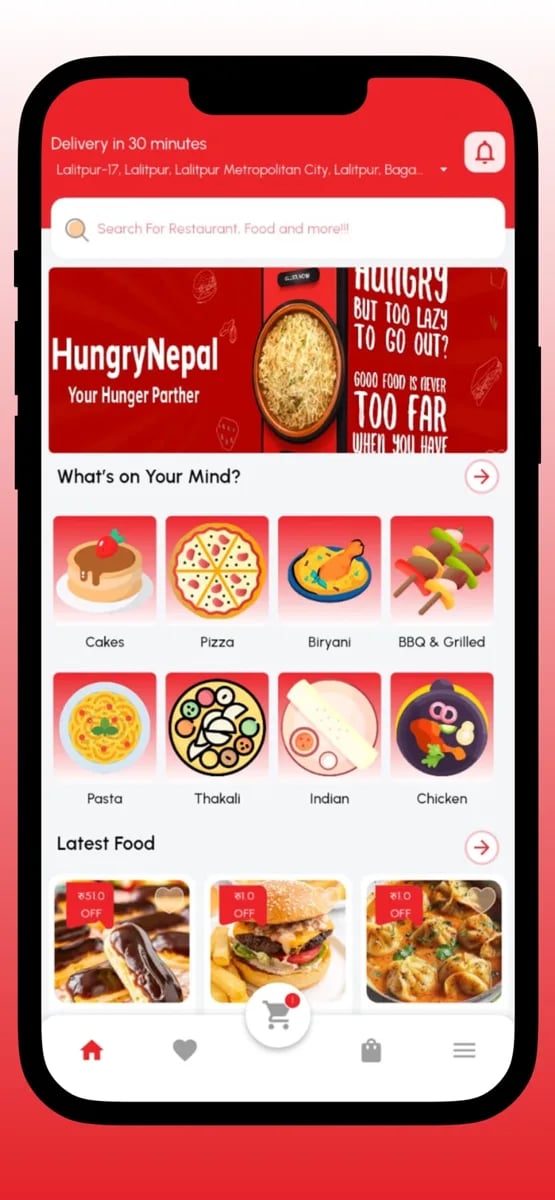
The customer app opens on the restaurants and dishes people actually want. Local favourites are easy to browse, and menus are organised so that a customer can move from deciding to ordering with very little effort. The experience is intentionally quick, because the moments when people order are often impatient ones.
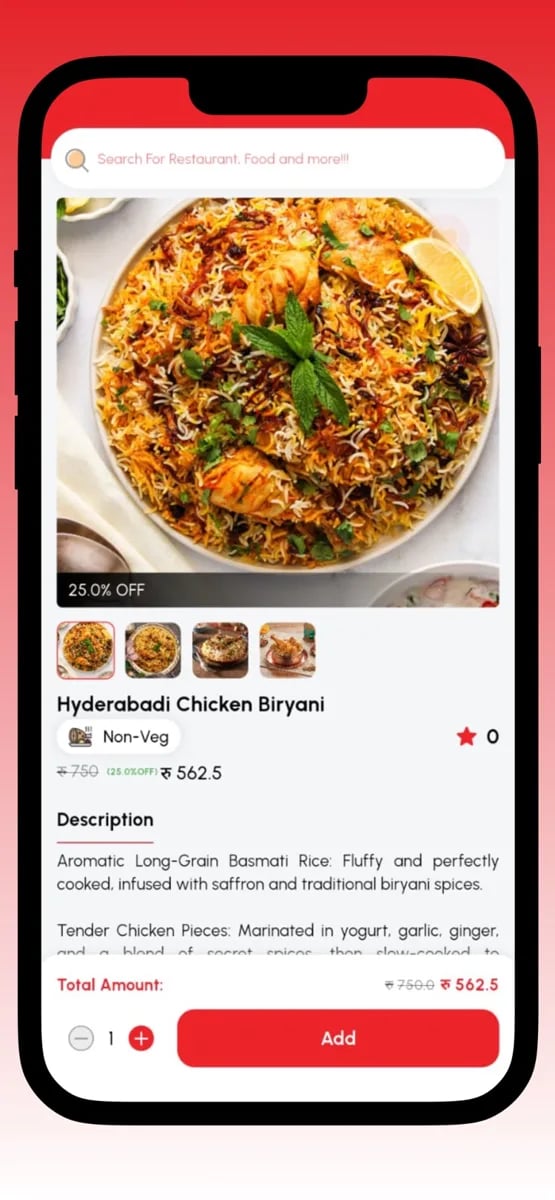
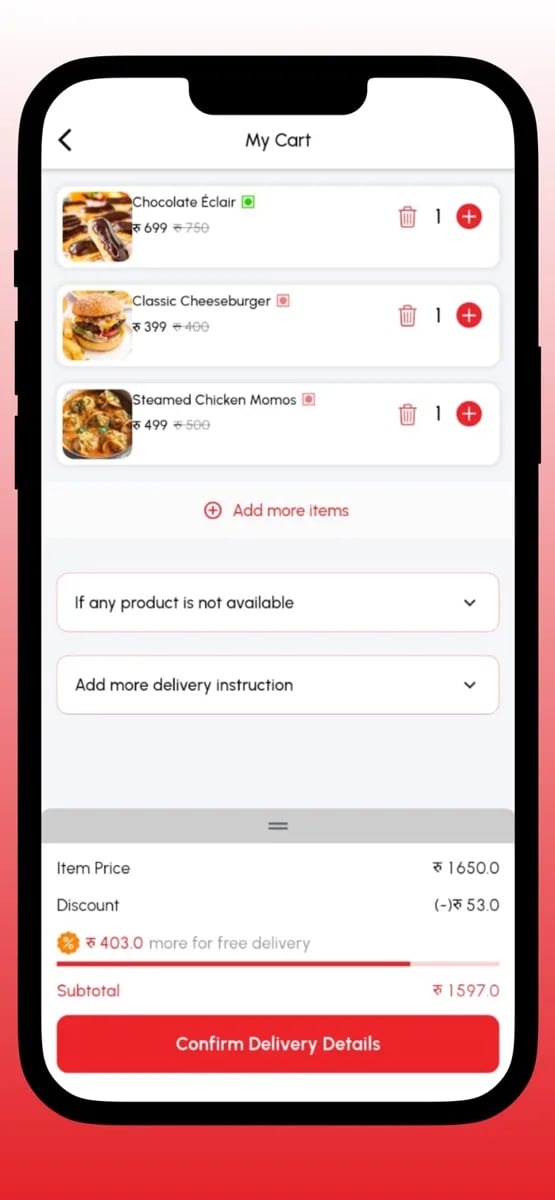
A restaurant's menu page shows what is available, with prices and descriptions, and adding to the basket is a single tap. The basket keeps a running total, lets the customer adjust quantities and carries them straight to checkout without detours.
Checkout collects only what is needed: the delivery location and the payment choice. Once an order is placed, the customer gets immediate confirmation and a clear next step, which sets the tone for the whole delivery.
- Browse local restaurants
- Simple menus and basket
- Quick, focused checkout
- Instant order confirmation
Overview
The Hungry Nepal story
Hungry Nepal is a delivery platform with a very clear local identity. It serves Hetauda, delivering food, drinks and snacks from local restaurants, at any hour of the day, in about half an hour to an hour. The promise is simple and appealing: hunger and good times do not follow the clock, so neither should the service. Whether it is a late-night craving, a gathering at home or a quiet evening in, the order should arrive when it is needed.
Delivering on that promise takes three cooperating products. Customers need an app that makes ordering effortless. Restaurants need an app that turns incoming orders into organised work and lets them keep their menu, hours and earnings under control. Riders need an app that tells them exactly what to collect and where to take it. We built all three, on one shared backend, so that an order placed by a customer appears in the kitchen and then on a rider's phone without anyone copying anything by hand.
The owner's own account of life before the platform is telling. Orders were taken on two phones and written in a notebook, which is a perfectly workable way to run a small business until it grows. The moment volume rises, that system becomes a bottleneck and a source of mistakes. Moving to a platform where orders arrive digitally, riders are notified and everyone can see the status gave the business room to grow.
What made the project rewarding was seeing how directly software changed a day-to-day working life. A restaurant that no longer juggles phone calls, a rider who no longer has to ask for directions and a customer who can see where their food is are all outcomes of the same underlying system. We designed the product around those lived improvements, not around a feature list.
The challenge
What had to be solved
The first challenge was coordination across three groups in real time. When a customer places an order, the restaurant must accept it, prepare it, and hand it to a rider who then delivers it. Each handover is a point where information can be lost or delayed. The platform had to keep all three views of an order consistent, with clear statuses that everyone trusts.
The second challenge was the restaurant side. Many restaurants had never used software to manage orders, menus or opening hours. The partner app had to be understandable in minutes, usable on a phone in a busy kitchen and forgiving of the quick, imperfect way people work during a rush. If it was harder than the notebook it replaced, it would not be used.
The third challenge was delivery in a smaller city. Maps, addresses and landmarks do not always follow the neat structure that big-city apps assume. The rider app needed to present customer locations in a way that riders could act on, with map support and clear details, so that deliveries stayed close to the promised time.
The fourth challenge was operating around the clock. A service that promises to be available at any hour cannot afford downtime or confusion in the middle of the night. Notifications, status changes and order handling had to be reliable at two in the morning just as they are at dinner time, and the team needed visibility of what was happening.
Project goals
- Let customers browse local restaurants and order in a few taps.
- Give restaurants a simple app for menus, hours, orders and earnings.
- Give riders a clear app for receiving, collecting and completing deliveries.
- Keep every order status consistent across all three apps.
- Support quick delivery within about thirty minutes to an hour.
- Give the team visibility to run the platform around the clock.
Scope
What a product like this covers
- 01
- Multi-restaurant discoveryBrowse many local restaurants in one app.
- 02
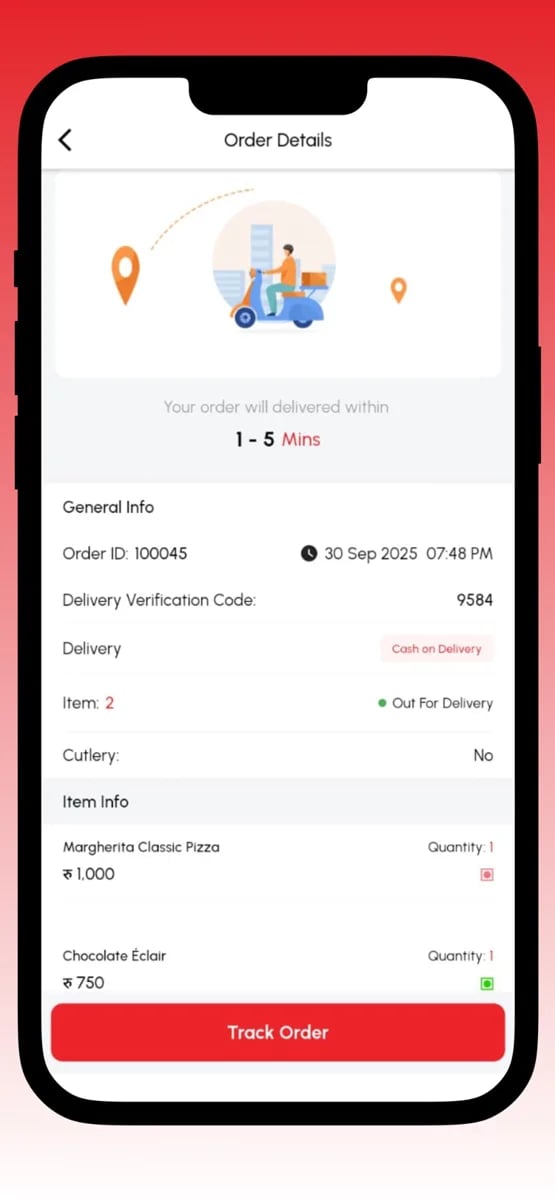
- Delivery verification codeA code on each order that confirms the right customer receives it.
- 03
- Basket and checkoutA short path from choosing food to placing an order.
- 04
- Live order trackingClear stages from accepted to delivered, with delivery progress on the map.
- 05
- Cash on deliveryCustomers can pay in cash when the order arrives, alongside order history.
- 06
- Menu managementPartners update items, prices and availability themselves.
- 07
- Opening hoursRestaurants set hours so customers only see what is available.
- 08
- Incoming order managementOrders arrive with full details and simple accept and progress actions.
- 09
- Rider assignmentOrders are assigned to riders who are notified instantly.
- 10
- Rider earningsRiders see deliveries completed and what they have earned.
- 11
- Sales insightsReal-time statistics on orders and sales for restaurants.
- 12
- SettlementsClear tracking of earnings and platform disbursements.
Engineering
The decisions behind the build
One backend, three apps
The customer, partner and rider apps share one backend, so an order has a single source of truth and every app shows the same status.
Real-time order flow
Orders, status changes and notifications move in real time, which keeps the restaurant and rider informed the instant a customer orders.
Menus the restaurant controls
Menu items, availability and hours are managed by the partners themselves and reflected immediately in the customer app.
Map-aware delivery
Locations and routes are handled with map support, with attention to the way addresses and landmarks work in a smaller city.
Earnings and settlement tracking
Sales, earnings and disbursements are recorded clearly, so restaurants and riders can reconcile their work with confidence.
Built to be monitored
Order flow and platform health are observable, which matters for a service that promises to be available at any hour.
Design principles
The rules we designed by
Replace the notebook, not the people
The goal was never to change how kitchens work, only to remove the copying and phone tag. We designed the partner app to match the rhythm of a real kitchen, so it feels like a faster notebook and not a new burden.
One order, one truth
When three apps show three different versions of an order, trust collapses. We made the order status a single shared fact, updated instantly and displayed consistently to customers, restaurants and riders.
Speed is the product
People order from Hungry Nepal because it is quick. Every screen was judged by how much time it adds to the journey, and anything that slowed ordering or delivery was simplified or removed.
Honest communication
Delays happen. We designed the apps to share news plainly and early, because customers forgive a late order far more readily than a silent one.
Respect the rush
Kitchens and riders work under pressure, so large controls, clear text and short flows were more important than polish. The apps should help during the busiest hour, not slow it.
Local first
Hetauda has its own rhythm, places and habits. We designed for them directly instead of copying a metropolitan template, and that local fit is part of why the platform feels trustworthy to the people using it.
Process
From brief to live release
- 01
Understanding the operation
We spent time understanding how orders were taken, prepared and delivered before the platform existed, so that the software would match real working life.
- 02
Designing the three apps
We designed the customer, partner and rider flows together, since a change in one always affects the others, and prototyped them for review.
- 03
Building the shared backend
The order flow, menus, accounts and notifications come first, because all three apps depend on them.
- 04
App development in sprints
We built the apps in short sprints with working builds to try, including on the phones the restaurants and riders actually use.
- 05
Field testing
We tested with real orders, real kitchens and real delivery routes, then fixed the awkward moments that only appear in practice.
- 06
Launch and support
We supported the release in Hetauda, watched early orders closely and continued improving as the service grew.
Screens
Hungry Nepal app screenshots
Quality and trust
How we keep it reliable
Order-flow testing
We test the whole path of an order, from placement to delivery, including cancellations and changes.
Notification reliability
New orders must reach restaurants and riders reliably, so we test notifications across device states and networks.
Usability for non-technical staff
The partner and rider apps are checked with real users to make sure they can be learned in minutes.
Data accuracy
Totals, earnings and settlements are verified so that restaurants and riders can trust their numbers.
Privacy
Customer details are shown only to the people who need them to complete an order.
Monitoring after launch
Once live, errors and stuck orders are tracked so they can be resolved quickly, day or night.
“Honestly, the first Friday after launch I didn't sleep. I kept refreshing the partner app to see if orders were coming in, and they were. Before this, my brother and I were taking orders on two phones and writing them in a copy. Now the riders get the order on their phone and I just watch. Hetauda ma yesto app aru kasaiko chaina, and people notice.”
Supesh Man Shrestha
Owner, Hungry Nepal, Hetauda
Looking back
What this project taught us
Hungry Nepal shows how much of a delivery business is coordination. The food, the restaurant and the rider already existed. What the platform added was a reliable way for them to talk to each other, and for the customer to see it happening. That connective work is invisible when it succeeds, and it is exactly where we spent our effort.
The project also reinforced the value of building for the real people at the edges of a product. The restaurant owner with a busy kitchen and the rider on a motorbike are not the loudest voices in a requirements meeting, but they decide whether a platform works. Designing with them in mind is the best way we know to make a marketplace dependable.
If you are planning a food delivery or multi-vendor marketplace, we would be happy to talk through how to shape the customer, partner and rider apps together.
It is also worth saying how much a local service benefits from a local relationship. The team behind Hungry Nepal knows their city, their restaurants and their riders personally, and the platform is a tool that amplifies that knowledge. Our job was to make the software disappear into the background so that the strengths of the people running the business stay in front.
About the Hungry Nepal project
Straight answers about how a product like this is planned, built and launched.
Still exploring? Let us help.
A small senior team, a developer assigned within 48 hours, and source code that is yours on full payment.
“Simple. Fast. My customers don't want to think, they want momo at midnight. The app does that.”
You can also write to us at hello@inflancer.com and our team will get back to you right away.
More case studies
Caller ID App
Callexa
Callexa is a communication platform that makes calls more meaningful, organised and transparent. Callers add a reason, recipients see it before they pick up, and calling, chatting, sharing and community support live together in one app.
Ride Sharing App
Yatra
Yatra is a ride-sharing app for bikes, cars and parcels. Riders set a pickup and drop-off, choose a ride and a fare, and follow their driver live on the map. Behind it sits the driver app and the operations tooling that keep a marketplace of trips running.
Flight Booking App
Damiticket
Damiticket is a flight booking platform for Nepal. Travellers search domestic flights, compare fares and classes across airlines and book in a few taps. We designed the search, comparison and booking journey so that choosing a flight feels as simple as it should.