We live in a world that is nothing less than a science fiction movie, today your phone can predict your next move, your computer can compose music, and your car can drive itself.
Well, this is a movie scene, it’s a reality shaped by Artificial Intelligence (AI).
This AI technology has evolved so much that now you have the power to predict weather patterns, recommend a good book, or even diagnose a disease everything from the palm of your hand.
These capabilities are not some kind of superpower but rather a result of AI apps that are increasingly becoming an important part of our daily lives.
From personal assistants like Siri and Alexa to advanced healthcare diagnostics, AI applications are changing how we live, work, and play.
Did you know? It is estimated that approximately 230 million people have used AI apps in 2024 and ChatGPT was the most downloaded chatbot app with 209 million downloads.
But have you ever wondered how these AI apps are created?
What if you could develop an AI app that reflects your unique ideas and solutions?
The good news is, yes you can build your AI app too. It doesn’t matter whether you’re an experienced python developer or just a tech lover with no coding background.
You must be thinking how?
Well, keep reading this blog, as we’ve compiled everything you need to know about AI apps, including a step-by-step guide to building one.
Does It Take A Lot Of Effort To Develop An AI App?
Well, yes it takes lot of efforts to develop an AI app. AI is a complex technology and which is why a careful planning along with good expertise in machine learning and a huge amount of data is required to merge it in the app development process.
But, the efforts required depends on the complexity of the App and & it’s features. There are basically 3 types of AI Apps:
- Simple AI Apps: Simple AI apps can include basic chatbots or recommendation engines. The development process of simple AI apps usually takes 1 to 3 months and it generally requires a small team, making it easier to manage.
- Average AI Apps: These types of apps involve advanced features like AI-powered image recognition or chatbots with natural language processing. Which is why the development of average AI apps takes more time (3-6 months) and it requires a larger team, making the process more demanding.
- Complex AI Apps: It can take over a year to develop a complex apps with deep learning models or real-time machine learning. Complex apps usually need a significant investment in time & resources for its development.
The level of effort to develop an AI powered app depends on following factors:
- Availability of data: AI depends completely on data. The more complex your app, the more data you’ll need to train your AI models effectively. Collecting and processing large amounts of data can be really challenging.
- Existing tools and libraries: Fortunately, there are pre-built AI tools and libraries available that can streamline development process for certain functionalities. Using these tools can help reduce effort, especially for simpler apps.
- Your team’s expertise: Having a team with the necessary skills in AI, data science, and app development will significantly impact the effort required. You might need to invest in training or hire resources if your team is lacking in expertise.
6 Steps To Build An AI App
Creating an AI app involves a blend of old software development methods along with complex machine learning technology. Here is a detailed guide that will make you understand this process step by step:
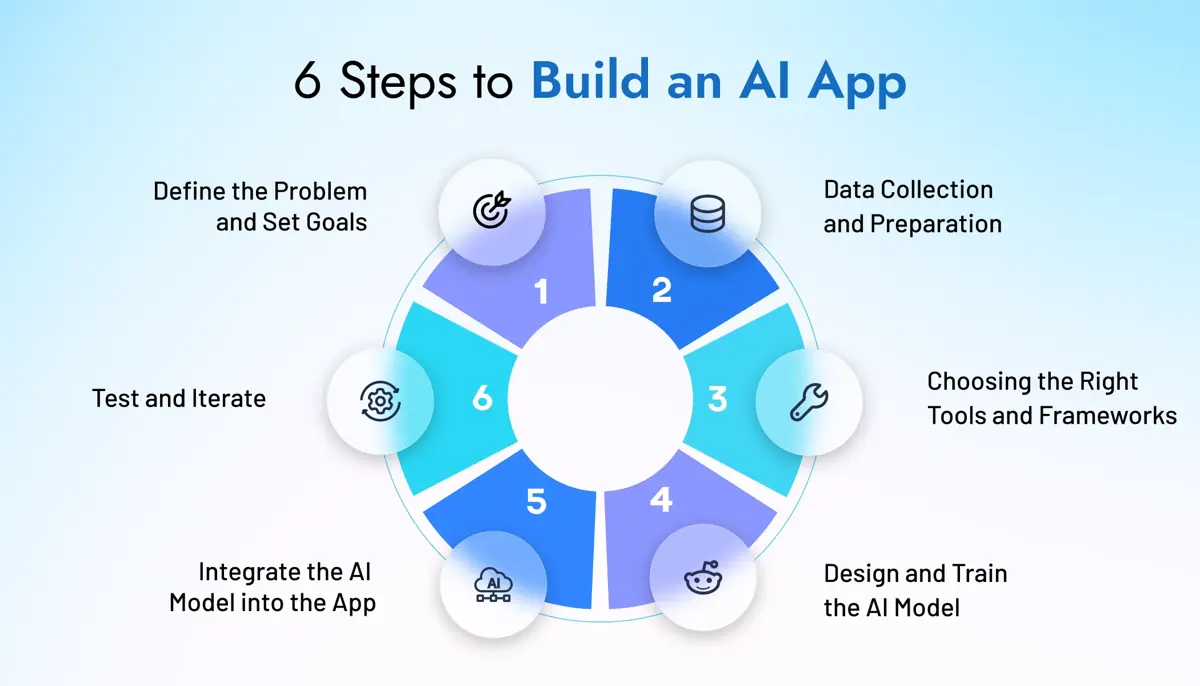
1. Define The Problem And Set Goals
Identify the Need
The very first and the most important step is to understand the problem that you want your AI app to solve. What particular task or challenge your app is addressing? Like is it recognizing images, filtering spam, or giving personalized suggestions? Clearly defining the purpose will make the entire app development process easy.
Set SMART Goals
Once you got to know the problem that your AI app will solve, establish a SMART goal that is,
- Specific
- Measurable
- Achievable
- Relevant, and
- Time-bound
Ask yourself – What functionalities this AI app will have and how you will measure its success?
2. Data Collection And Preparation
Data Gathering
AI models learn from data. You’ll need a lot of good-quality data that’s relevant to what your app does. This data can come from different places—like public datasets, how users interact, or even readings from sensors.
Data Pre-processing
Raw data cannot be used in its original form and which is why you will need to clean it and organize it. This includes removing duplicate data, fixing mistakes and a proper arrangement of data into a suitable structure that works well for your AI model. You will also need to use the data pre-processing techniques like data normalization and feature engineering.
3. Choosing The Right Tools And Frameworks
Development Tools
You can either choose low-code/no-code platforms or the old programming languages. It totally depends on your expertise in development and the complexity of your project. There are some popular choices in the industry that include Python with libraries like TensorFlow, PyTorch, or scikit-learn.
Pre-trained Models
If you are creating model from the scratch then it can be a tough process, you can use pre-trained models available through cloud services APIs. These models can save you a lot of development time because these models can be adjusted and modified as per your requirements.
4. Design And Train The AI Model
Model Selection
Choose an AI model that fits best for your problem type. For example, use Convolutional Neural Networks (CNNs) for image tasks, Recurrent Neural Networks (RNNs) for sequences like text, or Transformers for handling complex relationships in data.
Model Training
Train your model using the prepared data. This means feeding the data into the model and adjusting its settings to reduce the errors. Training can be resource-intensive, so using cloud resources might be needed for complex models.
5. Integrate The AI Model Into The App
Development Integration
In this step you will integrate the trained AI model into your AI mobile app or software application. This means writing code to link the interface of the app with the functions of the AI model. Frameworks like TensorFlow Lite or PyTorch Mobile can make this easier for mobile app development chicago.
Test And Iterate
Rigorous Testing
Once you have integrated the AI model, check your app thoroughly to make sure that it functions as per your plan. Check its accuracy, speed, and how easy it is to use. Check for bugs and problems and fix them.
Iterative Improvement
AI development is a continuous process. Based on testing and feedback from users, you may need to refine your data, adjust the model’s structure, or retrain the model to achieve better performance over time.
Additional Considerations
When designing your AI app, focus on simplicity and clarity. Make it easy for users to understand and use. Ensure the app provides clear feedback so users know how to interact with its AI features smoothly.
Avoid biases in the data used by the AI to prevent unfair results. Use a wide range of relevant data to give accurate outcomes for everyone using the app.
To build trust, explain clearly how the AI makes decisions. This helps users feel confident in the app’s reliability.
Protecting sensitive information within your application should always be a top priority. Implement robust encryption, follow industry-standard privacy regulations, and ensure every data touchpoint is secure. With the right approach and the support of reliable AI development services, you can safeguard user data and maintain trust while delivering a seamless app experience.
Read more: How Much Does It Cost to Build an AI App Like Perplexity?
What Is The Cost Of Developing An AI App?
The cost of developing an AI app can vary widely based on several factors. Here’s a breakdown to give you a general idea:
- Complexity of the AI Model: Simple AI features, like basic recommendation algorithms, are generally less costly than complex tasks such as facial recognition or natural language processing.
- Data Collection and Preparation: Gathering and cleaning high-quality data can vary in cost. Purchasing large datasets can significantly increase expenses.
- Development Team Expertise: Hiring skilled data scientists, AI specialists, and programmers impacts costs.
Cost Range By Complexity
- Basic AI App ($30,000 – $60,000): Includes simple chatbots or basic recommendation engines.
- Average AI App ($60,000 – $150,000): Features like advanced image recognition or chatbots with natural language processing fall in this range.
- Complex AI App ($150,000+): Includes deep learning models or real-time machine learning applications, requiring substantial resources.
Additional Costs
- Cloud Infrastructure: Costs for storage and processing power needed to train and run AI models.
- Ongoing Maintenance: Monitoring and fine-tuning AI models for optimal performance.
Tips To Manage Costs
- Start Simple and Scale: Begin with achievable goals and add complexity later.
- Use Pre-built Tools: Leveraging existing AI tools and libraries reduces custom development costs.
- Explore Open-Source Options: Utilizing open-source AI frameworks and datasets can be cost-effective.
Tools And Resources Required For Building AI Apps
| Category | Benefits | Examples |
|---|---|---|
| Cloud-Based AI Platforms | Simplify development with pre-built tools and APIs for data storage, training, and management. | Google Cloud AI Platform, Amazon SageMaker, Microsoft Azure Cognitive Services |
| Machine Learning Frameworks | Offer control over development with libraries and tools for building and deploying models. | TensorFlow (Google), PyTorch (Facebook), scikit-learn (Python library) |
| Data Tools | Essential for managing data—collecting, cleaning, and processing it effectively. | Pandas (Python), Apache Spark (large-scale data processing), Amazon Redshift |
| Pre-trained AI Models | Ready-made models for tasks like image recognition or natural language processing. | TensorFlow Hub, Hugging Face Model Hub, OpenCV (computer vision tasks) |
| Development Tools and IDEs | Essential for writing and debugging code, tailored for software development. | PyCharm (Python), Visual Studio Code (various languages), Android Studio, Xcode |
| Additional Resources | Platforms offering courses on AI development, machine learning, and specific tool tutorials. | Online Courses, AI Communities |
What To Consider Before Building AI-powered Apps?
AI has come a long way, and it’s easy to see why everyone is excited about its potential to analyze, predict, automate, and generally make life easier.
But before you start building your AI app, here are some important questions you should ask yourself:
- Have you identified a real problem? Is there a genuine need in your business or the market that your AI app can solve?
- What’s already out there? What are the existing solutions, and what can you learn from their successes and failures?
- Is AI the best solution? Before committing to AI, make sure it’s truly the best option. Sometimes, a simpler, more traditional approach might work better.
- Are you considering ethics? Developing an AI app comes with ethical responsibilities. Think about data collection, privacy, intellectual property, and so on.
- Do you have the right team? Does your team have the expertise to build a solid AI model? If not, consider bringing in AI experts to help out.
A successful software project starts with sharp strategy and smart planning. Every hour and dollar matters, making the right digital product engineering solutions essential. The real risk isn’t the investment, it’s the opportunities your team could miss by not choosing the right direction.
When it comes to AI development, the stakes are even higher. The potential for innovation and growth is immense, but so are the challenges of getting it right. That’s why many businesses choose to hire AI app developers who bring the right mix of expertise, strategy, and execution to turn complex ideas into scalable, intelligent solutions.
Before you take the leap toward a new idea or solution, make sure you understand the problem deeply, validate the opportunity, and map out a strategy that supports sustainable growth. A free AI consultation can help you clarify the direction, uncover hidden challenges, and set the foundation for long-term success.
Conclusion
In conclusion, developing an AI application is both an exciting and challenging endeavor. Many businesses face obstacles such as limited access to quality data, insufficient computing resources, and the need to ensure their AI models are ethical and risk-free. However, these challenges can be effectively addressed by following a structured AI app development process.
For companies looking to accelerate their AI initiatives, choosing to outsource AI development to experienced professionals like Inflancer can streamline the journey, ensuring high-quality, scalable, and efficient AI-powered solutions in USA. By taking these steps, you can confidently move forward in building intelligent applications that transform your business.
Want To Make Your App Smarter With AI? Inflancer Makes It Easy.
Frequently Asked Questions
Get the weekly updates on the newest brand stories, business models and technology right in your inbox.