To start your unicorn journey as a startup, you should have a product development strategy that matches market demands and further looks for growth opportunities.
90% of startup companies probably fail because they do not even check if people want their product before they make it. They bounce the step of researching user needs and end up wasting a lot of time and money creating something that people already have.
- A good startup company must offer one product fit to market requirements.
- A startup company might have lack of funding to move to the next phase of business.
The cost of a full product development ranges from $20,000 to $100,000 or more. By the time it gets ready, competitors may have already launched similar offerings. A smarter approach is to begin with an MVP. MVP allows for rapid and inexpensive drive with real customers.
In 2024, MVP development is a major strategy for startups, providing them with a cost-effective, efficient, and iterative approach to product development that is essential for survival and success. However, you must take care of the essential steps before you start developing an MVP.
What is MVP?
An MVP is the most basic version of your product that you can make to check your main ideas and get feedback from your first users. It’s all about giving something useful to your customers with essential features. This helps you confirm if your idea works without spending too much money or time.
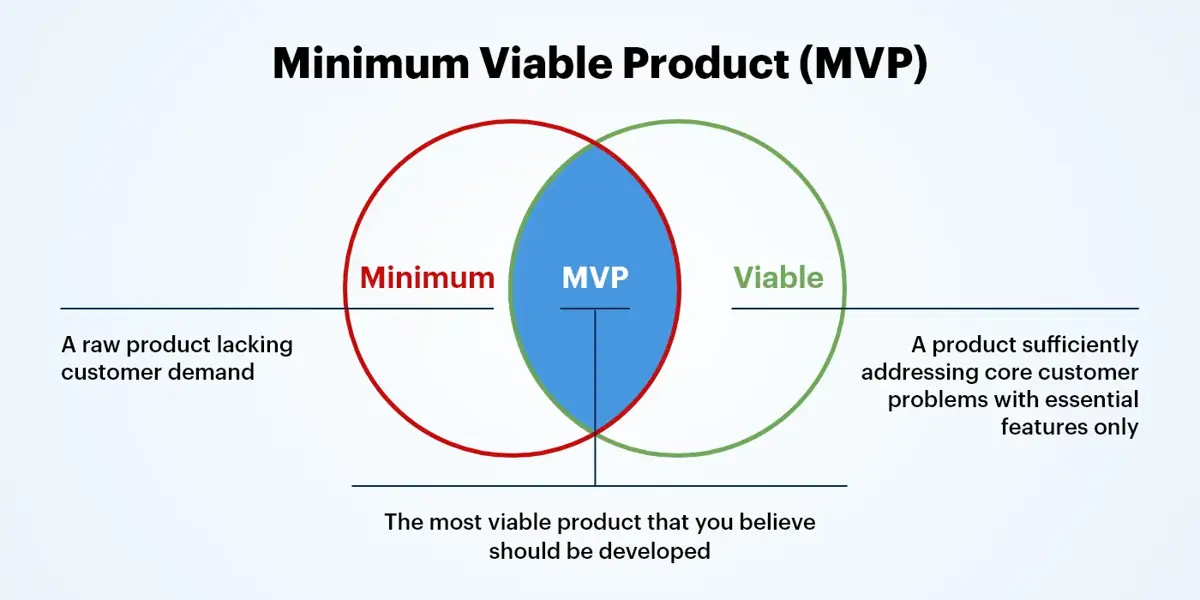
- MVP comprises core features to efficiently solve user problems and deliver significant value, minimizing development time and resources.
- MVP focuses on rapid iteration and feedback loop by releasing your product to a limited audience. It validates assumptions and adapts to market changes.
- Moreover, MVP has a balanced scope between delivering minimal features and ensuring high quality. This prioritizes smooth functionality to build trust with target audience and establish a strong foundation for future iterations.
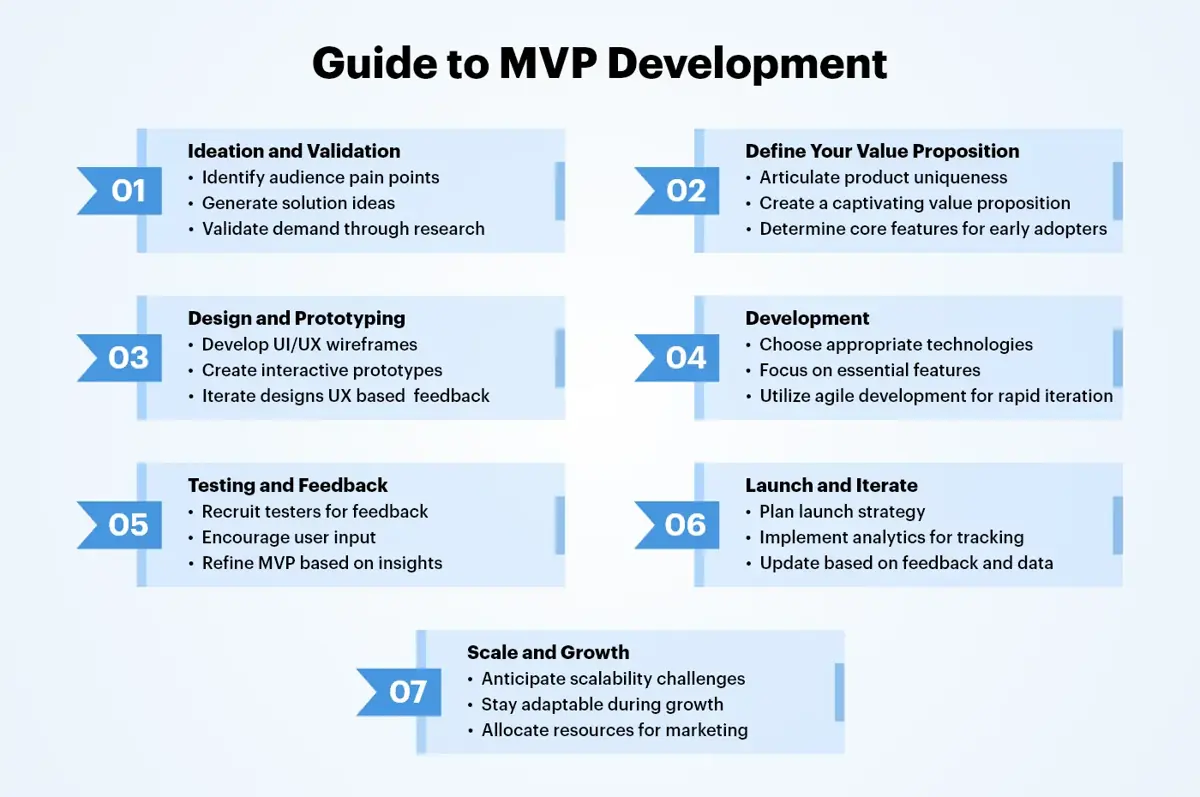
We’ve compiled a comprehensive MVP development checklist to help you navigate the exciting journey ahead. You should consider the points given below while developing MVP.
The 2024 MVP Development Checklist
Unlock your startup’s potential with “The 2024 MVP Development Checklist”. Efficiently build your MVP with essential features and user feedback. This helps you gain a competitive edge by refining your product based on real-world insights.
1. Ideation and Validation
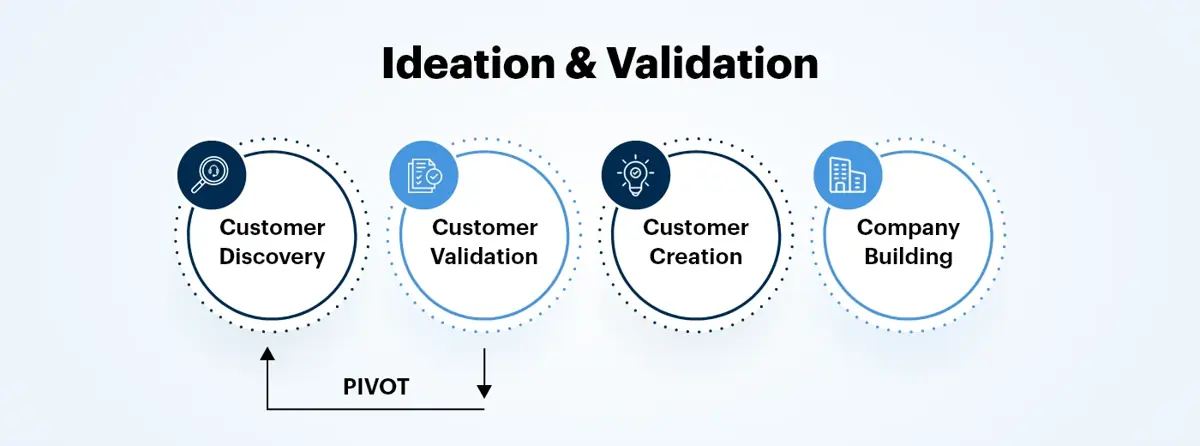
In the beginning stages of MVP development, it’s significant to come up with ideas and check if they’ll work. It is required to figure out the issues and demands of people that your product can solve. The key step to do so includes research, taking user opinions, and testing out ideas to make a successful product. By quickly trying out different versions and experimenting smartly, teams can check if their ideas are right and improve them before going further.
2. Identify a pain point or a problem that your target audience faces
Brainstorm Solutions and generate ideas on how to solve the identified problem. Conduct market research, surveys, and interviews to validate demand for your solution.
3. Define Your Value Proposition
After sanctioning that your MVP idea is worth it, the next step is to brief why it is crucial as per the current market demands. This means understanding what makes it unique and why people would choose it over other choices. This guarantees that the product meets users’ needs and boosts its chances of success.
Clearly articulate what makes your product unique and why customers should care.
Determine the core features that will deliver the most value to your target audience.
Collect user feedback to validate and refine your value proposition.
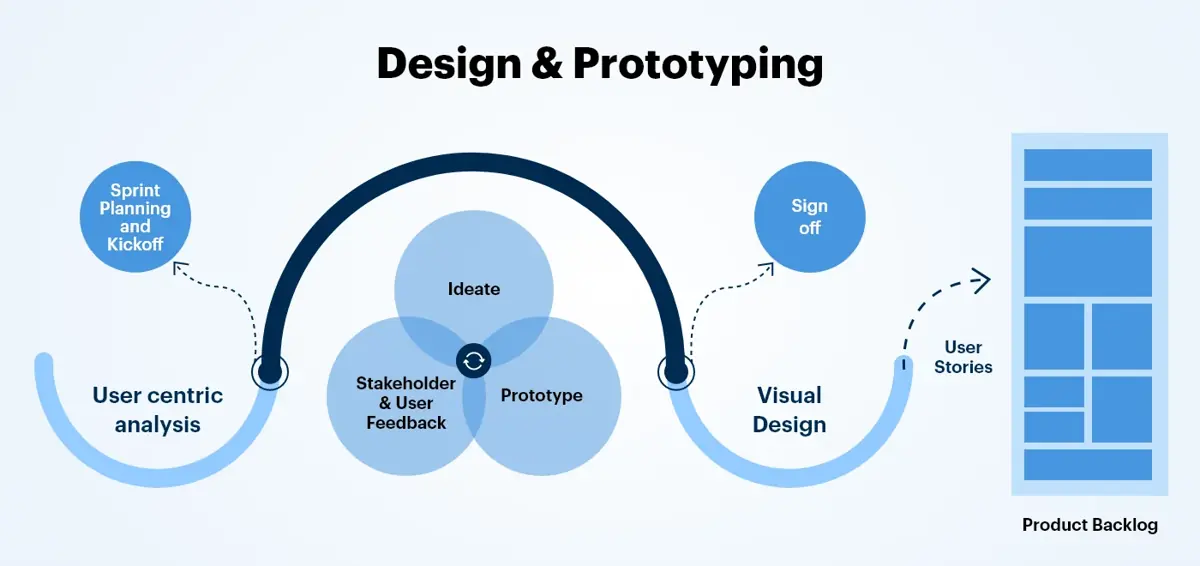
4. Design and Prototyping
Your next focus should be on designing appealing UX and making prototypes. Use smart design methods and rapid prototyping techniques to picture the product and gather user feedback. Utilize an iterative design methodology, to constantly enhance the design that aligns with user expectations for the final product.
Develop wireframes or sketches to visualize UI/ UX of MVP, to enhance user satisfaction and engagement.
Use prototyping tools to create prototypes for rapid iteration and simulating the functionality of your product.
Identify the core features necessary to deliver value to users and focus on implementing them in the initial MVP.
5. Development
During development, the team focuses on creating the main features of the MVP fast and well. They use methodologies like Scrum or Kanban to organize tasks and adjust to new needs. Regular testing makes sure the product stays stable and high-quality as it grows.
Select appropriate technologies and frameworks based on your product requirements and team expertise.
Focus on developing only the essential features that align with your value proposition.
Adopt an agile development approach to iterate rapidly based on user feedback.
6. Testing and Feedback
In MVP development, testing is significant. It helps teams find and solve problems before launching the final product. QA team performs different tests like user acceptance, usability, and beta testing to get feedback and check assumptions. This feedback loop is key for making the product better and matching what users want.
Conduct beta testing to identify and fix any issues. It includes functional, performance, and compatibility testing across various devices.
Gather feedback from users through surveys, interviews, or testing sessions to understand satisfaction and areas for improvement.
Use insights, prioritize enhancements based on feedback and iteratively refine your MVP to meet user needs and market demands.
7. Launch and Iterate
Once testing is complete, the MVP is ready for launch. Now, it’s time to gather feedback and data from real users. By constantly improving the product based on what users say, teams can decide what changes and new features are most important. Being flexible and quick to respond helps teams make the product better and meet users’ needs.
Plan your launch strategy and determine how you’ll introduce your MVP to the market and attract initial users.
Set up analytics to track key metrics such as user engagement, retention, and conversion rates.
Regularly release updates and enhancements based on user feedback and data analysis.
8. Scale and Growth
With the traction in MVP, it is required to scale the product and expand the user reach. In this phase, you should improve the infrastructure, introduce new methods for better scalability, and widen marketing activities. To continually enhance your product and ensure it aligns with user needs, remain vigilant about key metrics and user feedback.
Anticipate potential scalability challenges and plan for infrastructure upgrades as your user base grows.
Allocate resources to marketing and customer acquisition strategies to boost growth.
Remain flexible and adaptable as you just started navigating on the path to your unicorn journey.
Furthermore, the MVP approach is a lean management concept designed to enhance team productivity. It’s a startup methodology that emphasizes valuable activities, aligning with customer needs, and minimizing time and costs. These aspects are essential for many young entrepreneurs.
5 Top Benefits of MVP for Startups
Accelerate your startup’s success with an MVP. MVP focuses on essential features to save time and resources while gaining valuable user feedback. It reduces risk, optimizes innovation, and quickly adjusts to market needs. Have a look at the top benefits of MVP to take your startup forward and establish a strong foundation for long-term success.
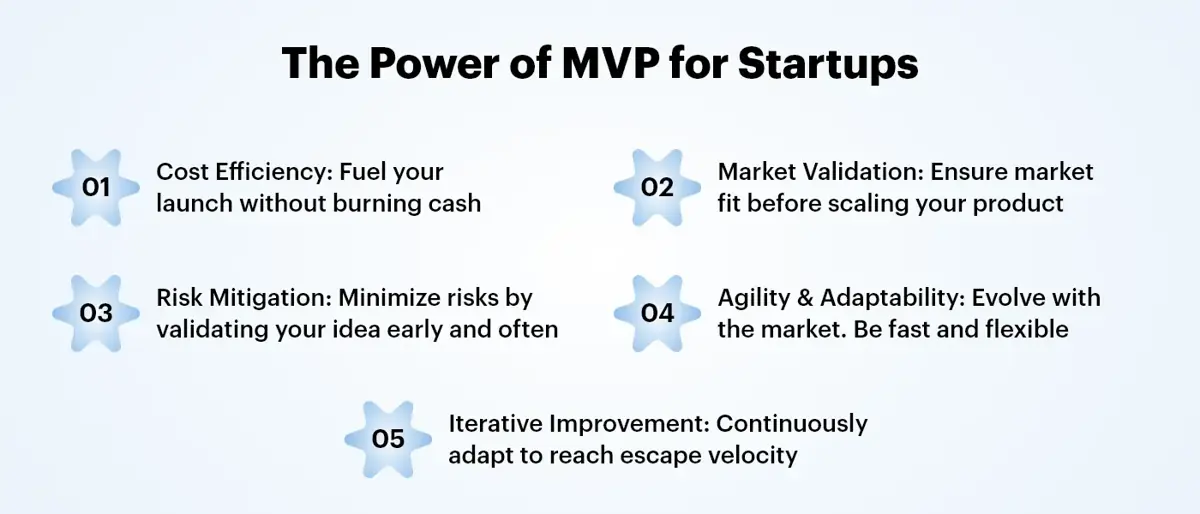
1. Cost Efficiency
Creating an MVP saves money compared to making a full product at once. By focusing on essential features, startups cut development costs, keeping money for future growth. This lean method is vital for bootstrapped or budget-conscious startups.
2. Risk Mitigation
Creating a full product without validating assumptions can be risky and expensive. MVPs help startups test their riskiest assumptions early, lowering the chance of failure. By validating demand, market fit, and usability through an MVP, startups can make smart decisions and use resources wisely.
3. Iterative Improvement
Startups evolve through iterations. An MVP provides the base for startups to improve their product using feedback and market insights. By following a feedback-driven approach, startups adapt to changing customer needs and outpace competitors.
4. Market Validation
When startups launch an MVP, they can see if their ideas work in real life. By checking things like how much users engage and how many people are converted as buyers, startups can make sure their idea is valuable and change it if necessary.
5. Agility and Adaptability
Agility is key to survival. MVPs help startups adjust fast to market changes, trends, and what customers want. Using an iterative approach, startups can change strategies and products, or explore new markets easily.
Conclusion
Building a startup is thrilling but the early stages can make or break your vision. That’s why crafting a strategic Minimum Viable Product (MVP) is essential. A well-executed MVP helps validate your idea, attract early users, and set the pace for scaling.
Through years of hands-on experience helping startups go from zero to one, Inflancer has become a trusted partner for tech-driven innovation. As a leading software development company in New York, Inflancer blends product strategy with technical expertise to build MVPs that are lean, user-focused, and ready to evolve.
The key? Launch with purpose. Focus on solving a real problem, listen to feedback, and keep improving. With the right foundation and the right partner, you’re not just launching a product, you’re laying the groundwork for a potential unicorn.
Begin Your Unicorn Journey! Follow The 2024 MVP Checklist & Kickstart Success.
Frequently Asked Questions
Get the weekly updates on the newest brand stories, business models and technology right in your inbox.