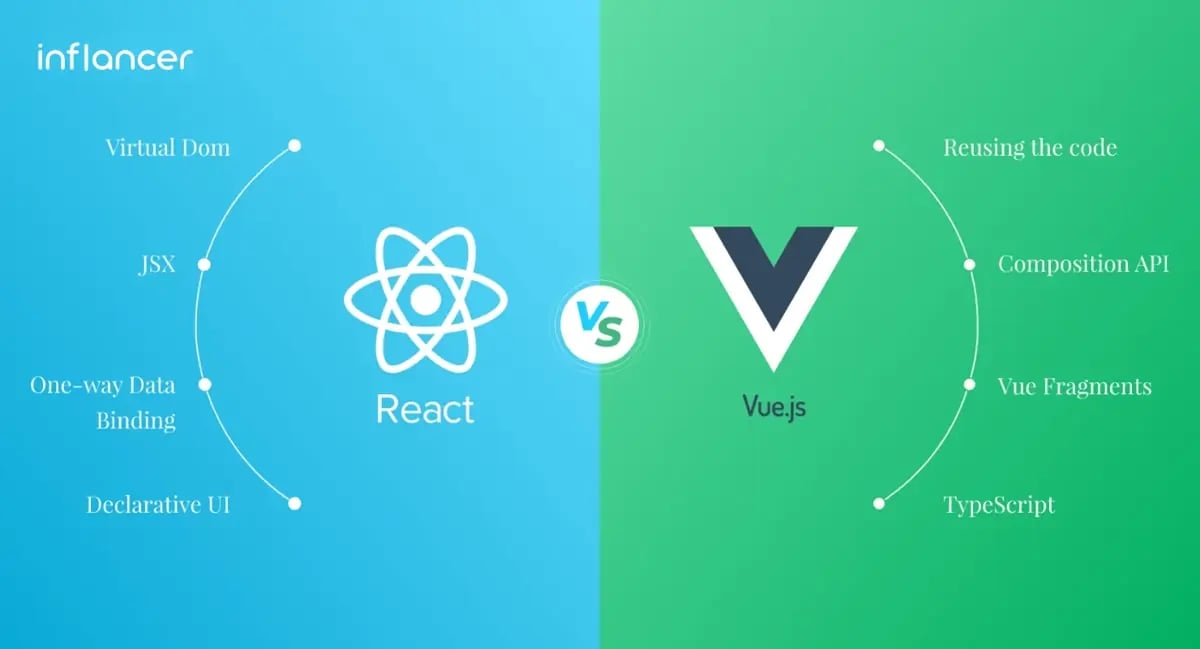
React and Vue are a JavaScript-based front-end development library. Both the frameworks that twin to develop a high-quality web solution in a minimum timeline are scaling rapidly with a soared demand. This tug of war between the duos to prove itself apt is technologically turning into a tussle for web development companies as well as entrepreneurs looking for an aesthetically appealing front-end web development.
There are dozens of JavaScript-based frameworks but React.JS and Vue.JS development is the most popular and widely used frameworks among JavaScript developers. Both the frameworks possess multiple similarities and differences which put companies into the dilemma of choosing the most appropriate development solution for the specific project.
To eliminate such a muddle, let’s take a ride to React.JS and Vue.JS features, pros and cons in detail by conducting a comparative analysis. This will surely help you land on the decision of which one is better! And guide you to determine which framework will be most suitable for your next project. Keep reading.
What is React.JS?
React.JS is an open-source, Facebook-owned JavaScript library. It is an efficient, flexible, and declarative library to build a simple, quick, and scalable front-end of the web application with ReactJS. Exploring full stack developer skills helps developers understand how React.JS fits within the complete frontend and backend technology stack that modern web development roles demand. By using declarative code, the React developers can develop an interactive and captivating user interface, quite efficiently and predictably.
React is a component-based JavaScript library that can be used to develop the application’s view layer. React development can offer multiple extensions and architectural support to the complete application, such as React Native and Flux.
- React is a suitable tool known for developing mobile applications and single-page apps.
- It follows MVC (Model View Controller) Architecture to develop the view layer, which is responsible for managing web and mobile applications.
Features of React.JS
- Scalable: It is a suitable library for large-scale applications because of its scalable and adaptable feature that helps it to introduce new updates without hampering the ongoing app.
- Rich JavaScript Library: Developers from around the world can explore and integrate a number of libraries to include more features in the digital solution.
- Code Reusability: While working on the project, developers can reuse the same code components of different levels.
- On-Way Data Flow: To keep the data unidirectional, React.JS implements a one-way data flow by using the Flux pattern.
Pros & Cons of React.JS Development
Pros
- Easy To Learn: React.JS is an open-source library, so there are loads of tutorials, training tools, and other learning stuff that can support new and experienced React.JS developers to brush up their skills. On the other hand, for those who are already familiar to JavaScript, for them learning React.JS is just a matter of a few days.
- Highly Efficient: React.JS is a highly efficient and demanding web app development tool. In React.JS Web App Development, the complete virtual DOM updates whenever any updates are introduced. This results in the existence of pre and post-updated versions of virtual DOM. The availability of both versions allows optimization and introduction of updates in real DOM quite easier and takes much less time, which ultimately increases the overall efficiency.
- Reusable Components: With React.JS web development it is easier to use pre-built open-source libraries and previously created UI components to other parts of the project or in different projects. The React.JS developers can also introduce some or no changes in these integrated libraries. Ultimately, it decreases development time and budget.
- One-Way Data Flow: One-way data flow introduces more stability and streamlines the codes where data flow follows the top to bottom approach or parent to child. In other words, in a one-way flow, the data only moves on a single path or in a single direction between the elements in React.JS development. This, one-way data flow minimizes errors and eases the debugging process.
- SEO Friendly: Web developers always used to be concerned about the site’s performance in global search ranking. In that JavaScript builds a heavy website that makes it difficult for search engines to track. This issue gets resolved by React.JS Web Development which introduces a lightweight and easily readable website by Google and other search engines.
Cons
- Development Pace React.JS is one of the most unstable tools in terms of introducing new updates and facilitating developers. But the pace at which React.JS is evolving seems quite negative and positive both from a developer’s perspective. Such multiple updates are improving the development pace and time yet is making it difficult for developers to frequently update their learning to move alongside with the updates.
- Complicated JSX React.JS uses JSX syntax extension for developing JavaScript objects with HTML syntax. This process streamlines the Document Object Model (DOM) modification process and also makes codes more readable. But, understanding of JSX syntax seems easier for some developers, simultaneously difficult for other groups.
- Incomplete Set of Development Tools A web app development is not only about UI development, and apart from web development React.JS fails on everything. So, to ensure the proper web app development, the React.JS developers have to look for other supporting tools to complete the project.
What is Vue.JS?
Vue.js is an open-source JavaScript framework for building user interfaces and single-page applications. It is known for a gentle learning curve, flexible structure and built-in tooling, which makes it a popular alternative to React.js.
Vue.JS is a progressive JavaScript framework for developing User Interfaces (UIs) and Single-Page Applications (SPAs). It can work as a library and framework both based on the development requirement. It works on an MVVM (Model-View-ViewModel) architectural pattern which allows business model or logic, to be differentiated from graphical UI or view.
Vue.JS is a combination of Angular and React, where the best parts of both are put together, like a two-way data binding. This results in Vue.JS development and turns out to be a better version of both Angular and React.
Vue.js stands out as a flexible, lightweight, and easy-to-learn framework, making it a strong choice highlighted in any Vue.js hiring guide. At the same time, it offers a complete and feature-rich ecosystem that can evolve and scale to meet the demands of advanced web application development.
Vue is a lightweight framework and implements virtual DOM, which specifically speeds up rendering and makes it a much faster tool than others. In addition to that, Vue.JS is an intuitive framework with easy syntax.
Features of Vue.JS
- Adaptability: Vue.JS ensures stress-free migration and efficient structure.
- Components: In Vue.JS development, the custom elements can be designed, which are reusable in HTML.
- Transition: Vue follows multiple methodologies to implement alteration to HTML components whenever it is included or excluded from the DOM (Document Object Model).
- Detailed Documentation: A detailed documentation process in Vue introduces easy and quick learning which represents an overall simple learning curve.
Pros & Cons of Vue.JS Development
Pros
- Lightweight: This JavaScript framework is small in size, and this size plays a vital role in gaining acceptance among developers. As developers can instantly fetch all the online available files and can efficiently outperform heavy tasks in web app development with this tiny Vue.JS framework.
- Legible Syntax: Developers’ familiarity with JavaScript programming makes it easier for developers to have an instant grasp of Vue.JS, due to legible and simple Vue Syntax. Whereas, the experienced developers who switch to Vue, find its syntax quite intuitive. The Vue component is a combination of a simple structure of JavaScript and HTML. It’s simple structure enables large-scale template development and easy to track errors.
- Easy Integration: Vue.JS supports easy integration with a variety of apps and this easiness makes it popular for web app development. In contrast to other JavaScript frameworks, Vue.JS supports the development of a whole single-page application and also integrates its components in the existing apps.
- Scalable and Versatile: Vue.JS plays a dual role whenever requirement arises, it can upgrade from a library to a full-fledged framework. Such, flexibility no other framework supports. This is why developers prefer Vue.JS web app development, so that they can easily modify, update, and scale it up, as per the app demands.
- Documentation: Vue.JS has very well-organized and detailed documentation to make learning easy and quick. It supports the learning of a Vue.JS developer with basic knowledge of JavaScript and HTML to ensure seamless Vue.JS Web App Development.
Cons
- Few Components/Plugins: The plugins and components make development easy as they can easily integrate with a variety of tools. This is where Vue.JS lacks- it doesn’t have most of the common plugins which hamper the development experience.
- Over Flexibility: Flexibility is good but excess of anything is not at all welcomed. Similarly, when multiple developers are working on the same project, then this flexibility could cause errors and generate irregularities within the code. It ultimately, over-complicates the whole development process, and will also delay the project and increase the development cost.
Quick answer:
Choose React.js for large, complex apps that need a big ecosystem and a deep hiring pool; choose Vue.js for faster onboarding, small-to-mid-size projects and clean built-in tooling. Both are production-ready, so the right pick depends on your team’s skills, project size and long-term maintenance.
Read More: Top 7 ReactJS Development Companies in USA for 2026
Web Apps Built with React and Vue
React and Vue are one of the widely accepted and most used JavaScript frameworks or libraries. Here is a list of popular companies that use these tools for their customized web app development.
Popular Platforms Developed on React.JS are:

- Yahoo
- Dropbox
- Netflix
- Atlassian
- Instagram, etc.
Popular Platforms Developed on Vue.JS are:
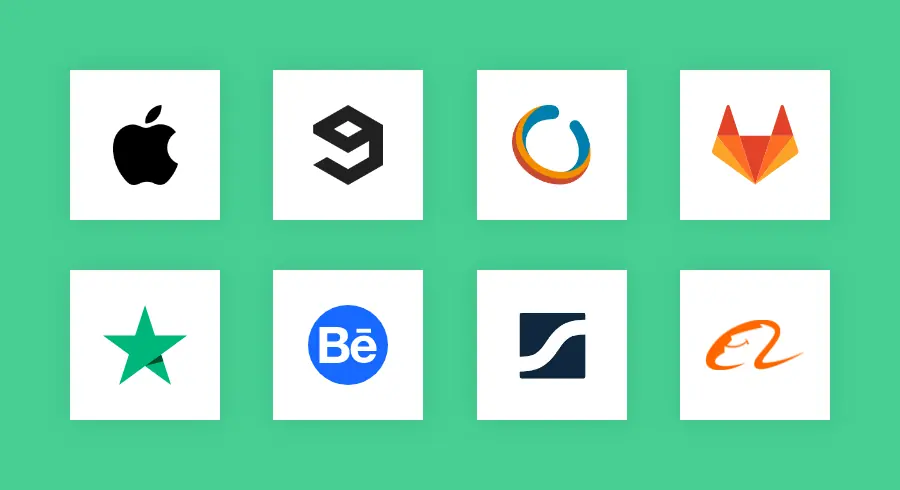
- Apple
- 9GAG
- Trivago
- Gitlab
- Trustpilot
- Nintendo
- Behance
- Statista
- Alibaba
React.JS vs Vue.JS: Which One is Better?
| Criteria | React.JS | Vue.JS V |
|---|---|---|
| Market Introduction | Introduced by ‘Facebook’ in 2013 | Introduced by ‘Evan You’ in 2014 |
| Tools | Third-Party CLI- Create-React-App | Official Vue-CLl |
| Flexibility | React.JS is not very flexible that provides out of box management. | Vue provides state management (VueX), Vue Server-Side Rendering, and Vue Router for Application URL management. |
| App Development | Does not use HTML and WebView,but have JS binding with Native Components. | East Syntax to understand using CSS / HTML/JavaScript. It has direct access to API of Native Platform. |
| State Management | Redux | Vuex |
| Performance | Average | Excellent |
| Development Cost & Speed | Relies on Project | Relies on Project |
| Data Storage | A huge of detail gets skipped and cannot use the use Selector function frequently | Good storage for each component, despite inconvenient syntax and transfer of props |
React and Vue both have strong features and tools to support web app development. Despite this fact, you need to be very precise and attentive towards these mentioned differences while deciding to choose React or Vue for web development.
Also Read: Comparison Between AngularJS and VueJS
The Final Call!
Both React and Vue are great tools to support complex web app development. Both provide a variety of possibilities and good performance to develop the app. The choice greatly depends on the project requirements. So, we recommend to always reach out to experts in making such decisions.
Inflancer has an expert group of Vue.JS and React.JS Web App Developers and can deliver a customized web solution for your business needs. Connect with our proficient team that can help you deliver an outstanding web solution for your end-users.
Pick A Right Choice From Vue.Js/React.Js Development For Your Next Project?
Frequently Asked Questions
Get the weekly updates on the newest brand stories, business models and technology right in your inbox.