Customers demand seamless, personalized, and convenient interactions with leading brands. Failing to meet these expectations can lead to customer frustration and missed opportunities. Conversational AI offers a way to address these demands by providing efficient and effective customer support and engagement. This technology encompasses a wide range of automated systems that can hold natural language conversations with users.
Businesses can potentially save between 15% and 70% on costs based on the number of customer channel interactions redirected to Conversational AI-enabled chatbot development.
AI Chatbots, voice recognition systems, and virtual assistants providing round-the-clock support, all come under conversational AI.
Amazon’s Virtual Assistant Alexa is a prime example of how conversational AI has transformed the customer experience. Alexa is embedded in smart devices. It helps allow users to monitor their environment, access information, and shop online with natural language commands.
- Conversational AI uses AI technology and natural language processing (NLP) to enable machines to understand, interpret, and respond to human language.
- Conversational AI is now considered as an integral part of customer service, marketing, and sales strategies across diverse industry verticals.
- It allows machines to communicate naturally with humans either through text or speech.
Besides, the conversation AI market has witnessed significant growth and adoption in the last 5 years. 90% of companies that use AI chatbots for customer service save up to 4 minutes per question and only pay $0.70 per interaction.
Key Components of Conversational AI
Conversational AI systems consist of several key components:
- Natural Language Processing (NLP)
This component enables the system to understand and interpret human language. It includes context, sentiment, and intent. - Machine Learning (ML)
ML algorithms are used to improve the system’s performance and responses over time. They allow the AI to learn and adapt. - Dialog Management
This part controls the flow of the conversation. It ensures that the interaction remains coherent and contextually relevant. - Integration
Chatbot development in Conversational AI supports integration with various data sources and systems to retrieve information and provide valuable responses.
Unlock the Advantages of Conversational AI
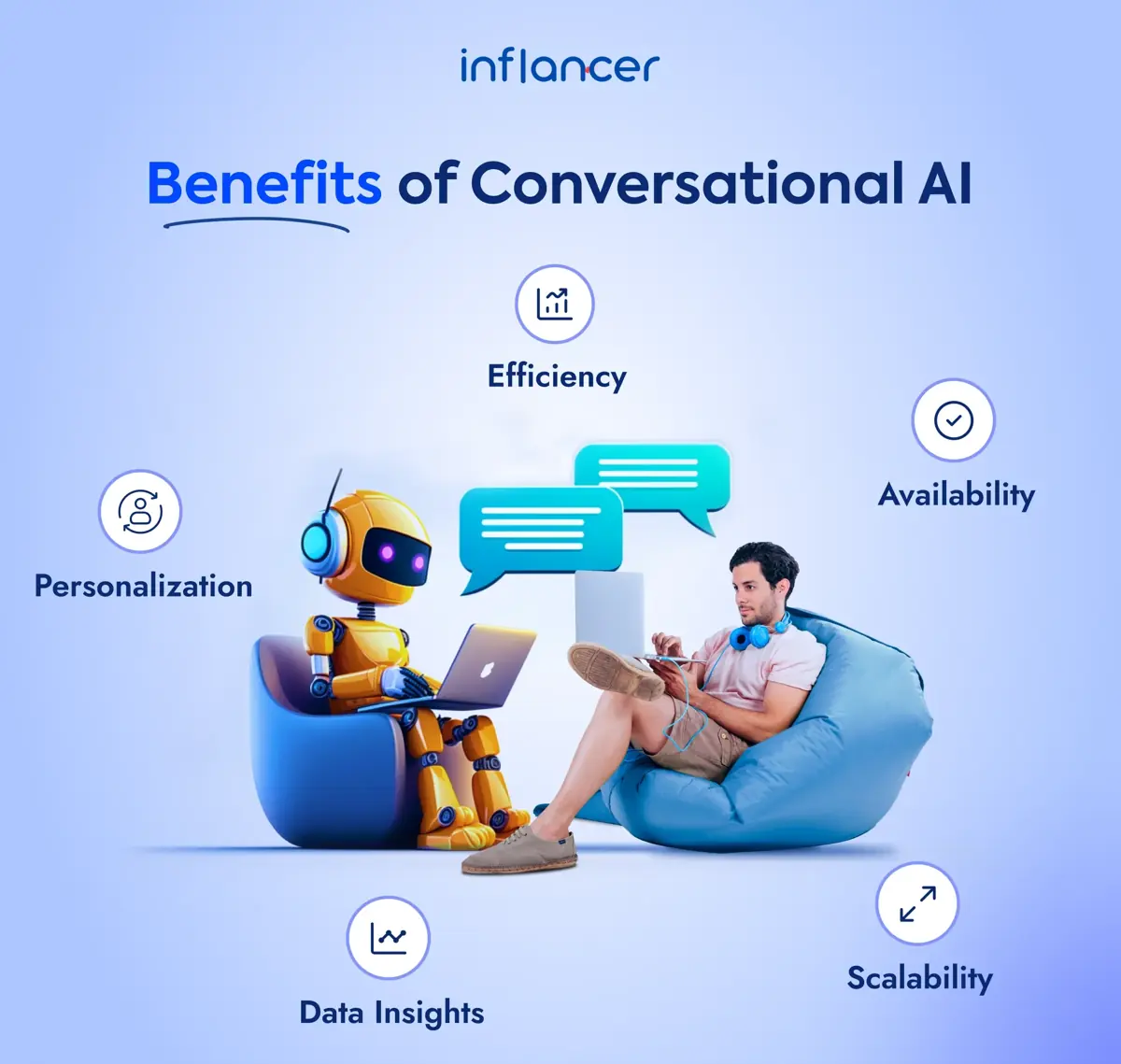
Conversational AI offers numerous advantages, including:
- Efficiency
It’s like having a super-efficient assistant. Conversational AI can take care of repetitive tasks and answer common questions, reducing the need for human intervention. This means businesses can save time and money while you get faster responses. - Availability
24/7 availability for customer queries, irrespective of time zones or working hours.
You don’t need to worry if you need help from a company and it’s the middle of the night. Conversational AI is available 24/7, ready to assist you. It doesn’t take breaks or need sleep, making it ultra-convenient for you. - Personalization
Conversational AI is like having a personal shopper. Conversational AI can remember your preferences and past interactions. This way, the AI Chatbot can suggest products or services that you’re more likely to enjoy, making your experience more personal and enjoyable. Further, chatbot development in AI gives added benefits to tailored responses and product recommendations. And, these are based on user data and preferences. - Scalability
Conversational AI has the ability to handle a high volume of conversations simultaneously. Whether it’s a slow day or a super busy one, it can keep up without breaking a sweat. This helps businesses serve more customers efficiently. - Data Insights
Gathering valuable data and insights from conversations. It helps in decision-making and improving processes.
Read More: Which is Better for Your Business in 2025- Chatbots or Conversational AI?
The Role of Conversational AI in Customer Experience
- Always There to Help
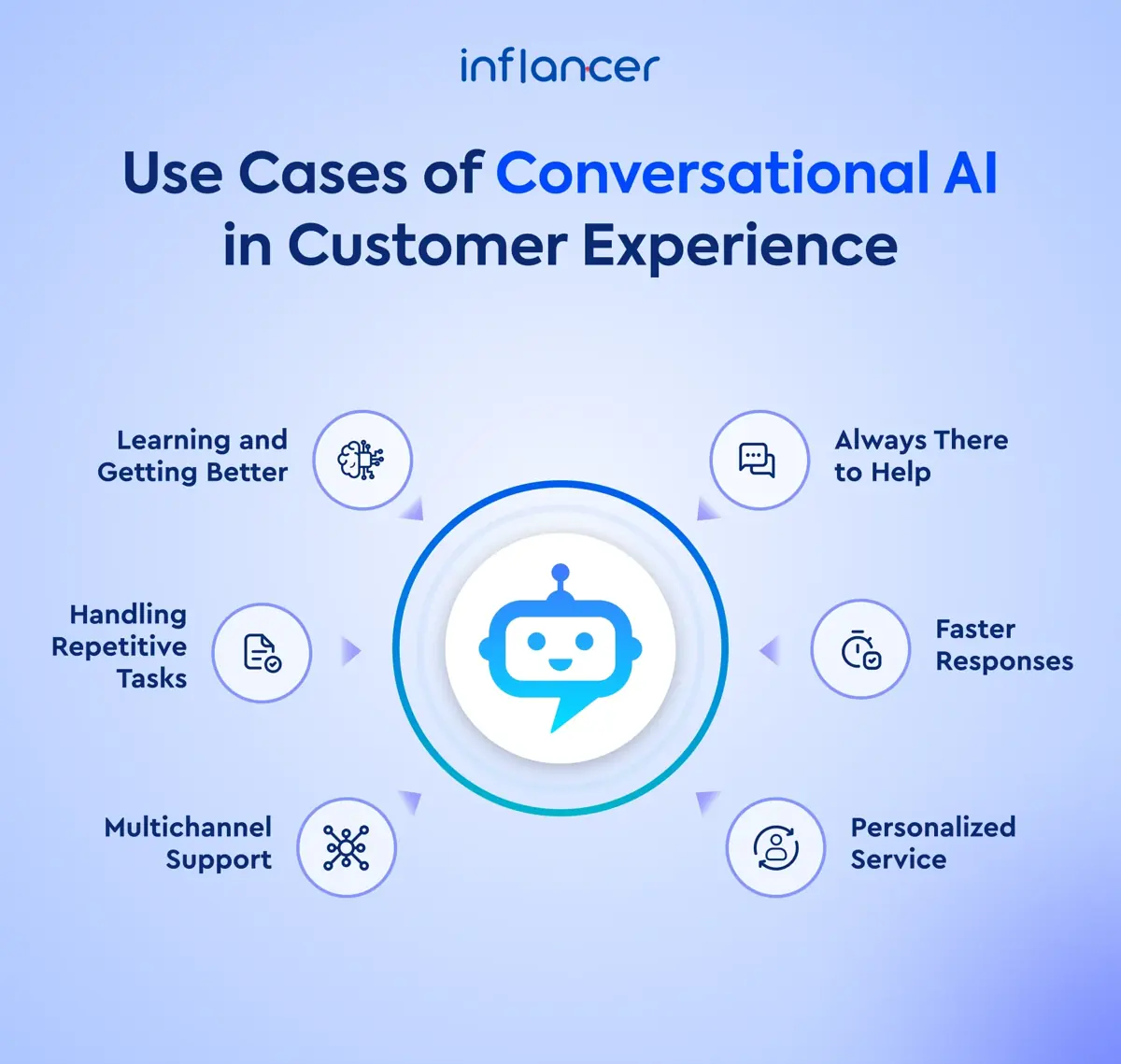
Imagine you have a question or need assistance from a company, but it’s 2 A.M., not a suitable time to call, right? Conversational AI doesn’t sleep. Conversational AI systems operate around the clock. It’s available 24/7 to help you. This means you can get AI Chatbot support or information when it’s convenient for you.
This is particularly valuable for global businesses with customers in different time zones. Immediate responses to inquiries, issues, or orders contribute to a positive customer experience.
- Faster Responses
People are used to waiting on hold or waiting for an email reply. Conversational AI can answer your questions instantly. No more elevator music or anxiously checking your inbox. AI Chatbot is like having a super-fast customer service agent at your fingertips. - Personalized Service
Have you ever noticed that some websites recommend products you might like? That’s Conversational AI and chatbot development at work. It can look at your past interactions and figure out what you might be interested in. Thus, you will get personalized recommendations and offers. This level of personalization enhances customer engagement and makes customer experience more enjoyable. Also, it fosters a stronger connection between the customer and the brand. - Multichannel Support
Conversational AI isn’t limited to just one way of communicating. It can seamlessly operate across various channels, allowing users to interact through website messaging apps, voice assistants, and other digital platforms. By integrating technologies such as RAG solutions, conversational AI can also deliver more relevant and context-aware responses based on the information available to it.
Hence, you can reach out to your customers in the most comfortable way.
- Handling Repetitive Tasks
What if you work in a customer support team and you need to answer similar questions 100-200 times a day? Isn’t it a tiring process? Well, Conversational AI doesn’t get tired. AI Chatbot is great at handling repetitive tasks. It can answer common questions such as “What’s your return policy?” without getting frustrated. - Learning and Getting Better
Conversational AI is like an intelligent student who continues to learn. It can learn from every conversation. If you don’t know the answer to something, you can learn from AI chatbots and get better next time. This means that it is constantly improving, which will benefit you.
Further, Conversational AI is not just a chat; it’s a transformation. It is doing its magic across industries, making processes smoother and customer experiences more delightful.
How Conversational AI is Working for Various Industries?
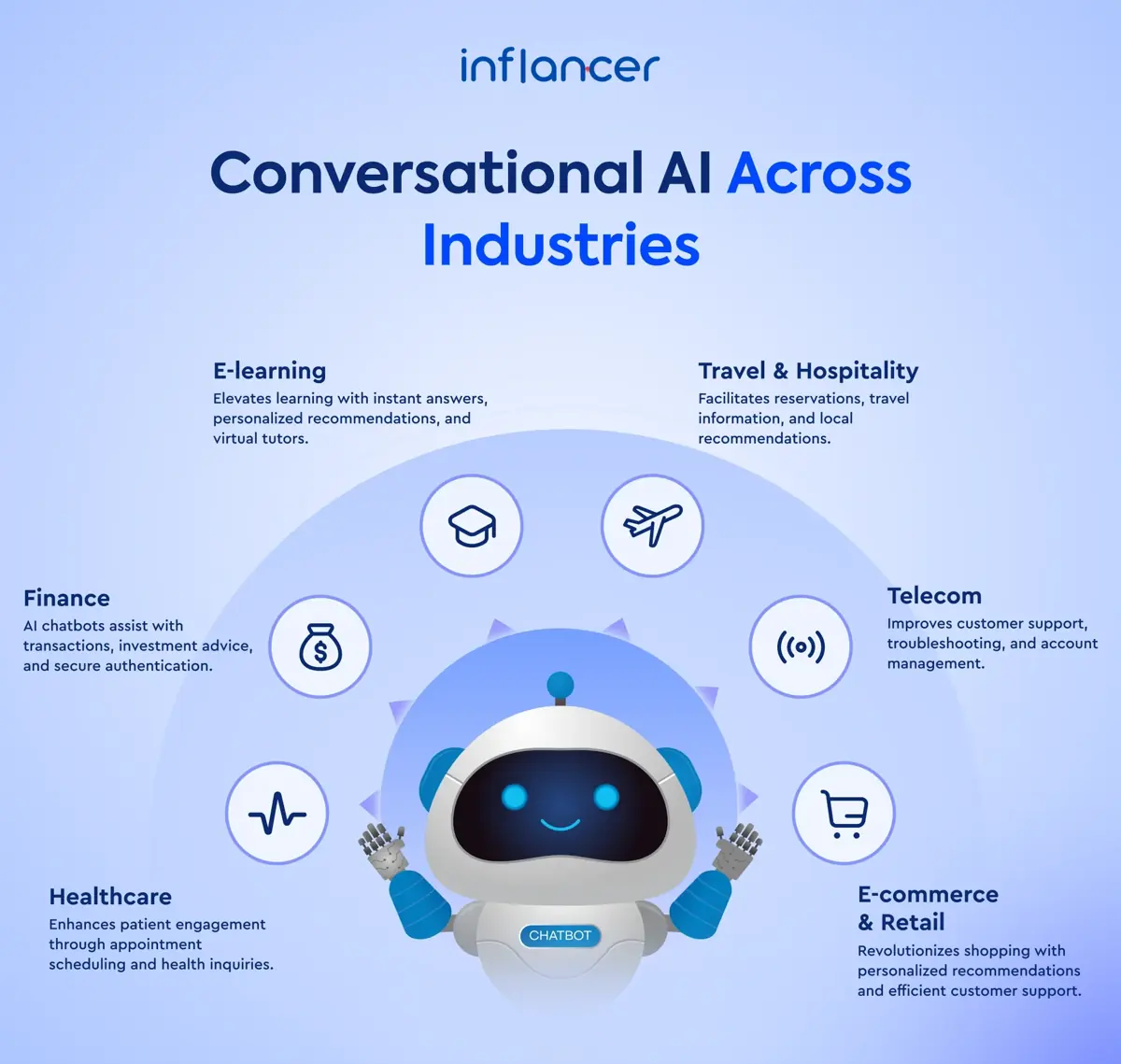
Conversational AI is revolutionizing diverse industries, from healthcare to e-commerce. It offers personalized support, enhances efficiency, and improves customer interactions.
- Healthcare
Chatbot development in conversational AI helps schedule appointments, provide medication reminders, and answer general health-related questions. These systems are also utilized for patient engagement, allowing healthcare providers to maintain a continuous dialogue with patients. - Banking and Finance
AI-based chatbot development is providing customers assistance with balance inquiries, fund transfers, bill payments, and even investment advice in bans and other financial institutions. It enhances security by enabling two-factor authentication through voice recognition. - E-learning
Conversational AI enhances the learning experience. It provides instant answers to student questions, delivers personalized study recommendations, and offers interactive lessons through virtual tutors. - Travel & Hospitality
In the travel and hospitality sector, Conversational AI facilitates hotel reservations, flight bookings, and journey management. The chatbot development in AI can also answer travel-related queries, give local recommendations, and offer caretaker services through virtual assistants. - Telecom
Telecom companies use AI chatbots for customer support, troubleshooting, and account management. AI Chatbot can help customers with network issues, billing inquiries, and plan customization. - E-commerce & Retail
AI Chatbot development is the most suitable option in the retail and e-commerce industry. Conversational AI is used for personalized product recommendations, order tracking, and customer support. AI chatbots and virtual assistants help customers find products, assist with checkout processes, and address inquiries promptly.
While Conversational AI brings great benefits, challenges do exist and need careful attention for its successful implementation.
Challenges to Overcome While Implementing Conversational AI
- Data Privacy and Security
Ensuring customers that their data is private and secure is one of the key challenges during the implementation of conversational AI. Organizations must implement strong data protection policies to prevent sensitive data and comply with data protection laws. - Integration with Existing Systems
Integrating AI Chatbot with existing IT systems and databases can be complex. Ensuring that the AI system can access the necessary information in real time and provide accurate responses is essential for a seamless customer experience. - Design and User Experience
The design and user experience of Conversational AI interfaces play a crucial role in customer satisfaction. Designing user-friendly and intuitive interfaces that customers find easy to use and navigate is essential. - Ethical Concerns
Chatbot development in AI becomes more human-like in its interactions, ethical concerns arise. Businesses must ensure that their AI systems are designed and used responsibly, addressing issues such as bias, discrimination, and transparency in AI decision-making.
It’s not just AI; it’s your future assistant. Conversational AI is shaping the way we interact with technology and services.
The Future of Conversational AI
The future of conversational AI holds endless possibilities, from even smarter interactions to seamless integration in our daily lives.
- Advancements in NLP and ML
Continued advancements in natural language processing and machine learning will lead to more sophisticated Conversational AI systems. These systems will understand context, sentiment, and intent. It results in even more human-like interactions. - Humanizing AI
The future of Conversational AI and chatbot development involves humanize AI technology. This includes giving AI systems a personality, enhancing emotional intelligence, and making interactions feel less robotic. Humanized AI will contribute to more authentic and engaging customer experiences. - Adoption & Integration
The adoption of chatbot development and related AI-based development is expected to grow across various industries. Integration with AR and VR technologies will expand the possibilities for enhancing customer experiences.
Conversational AI is not merely a passing trend, but rather a transformative revolution that will persistently progress and broaden in the forthcoming years.
In essence, it is reshaping the customer experience by equipping businesses with the means to offer exceptionally tailored, streamlined, and captivating interactions with their clientele.
Discover the Future of Customer Experience with Conversational AI.
Get the weekly updates on the newest brand stories, business models and technology right in your inbox.