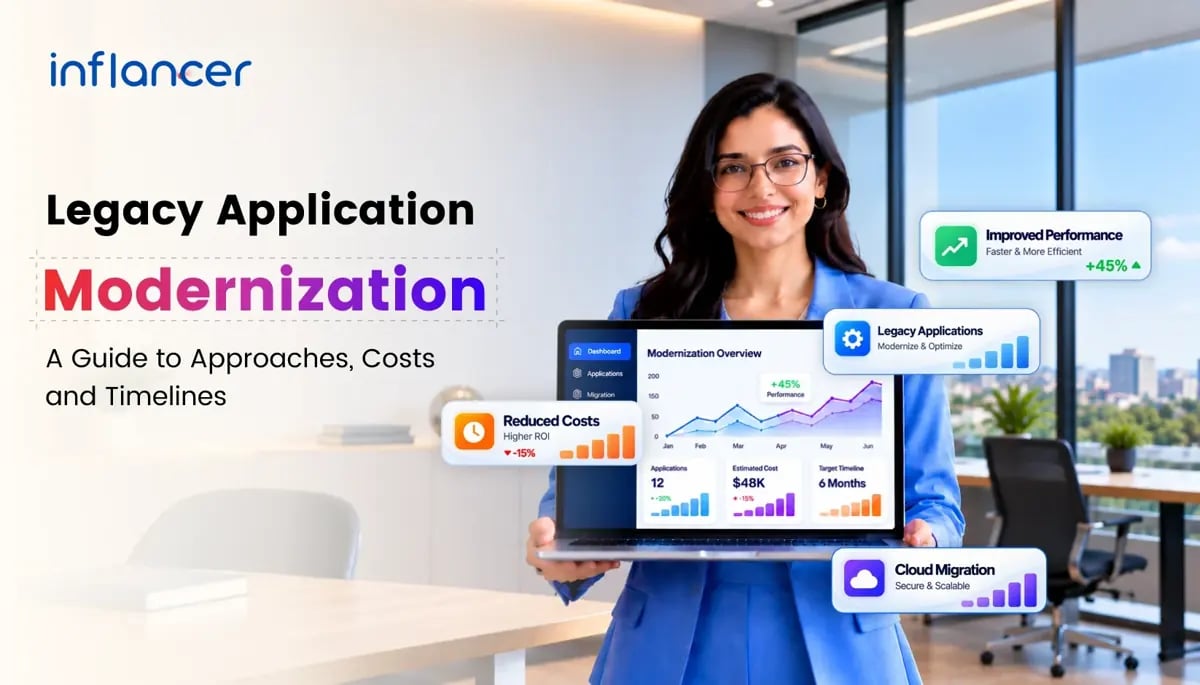
Legacy application modernization services typically take 3 to 24 months and cost between $50,000 and $1.5 million or more, depending on the approach, application size and integration complexity. Six approaches exist, from rehosting to full replacement, and the right one depends on business value, technical debt and risk tolerance.
Most enterprises apply a mix across their application portfolio, not a single method. At Inflancer, we have delivered 300+ modernization projects. According to the U.S. Government Accountability Office’s July 2025 report, federal agencies typically spend about 80% of their IT budgets on operating and maintaining existing systems, including legacy technology. The sections below explain modernization approaches, cost drivers, timelines by phase, the roadmap and how to choose a legacy application modernization company.
Key Takeaways
- Choose an approach for each application: Evaluate its business value, technical health, and dependencies before deciding whether to rehost, replatform, refactor, rearchitect, rebuild, or replace it.
- Assess before estimating: Application complexity, integrations, data quality, testing and downtime requirements shape the budget and delivery schedule.
- Plan beyond development: Include migration, parallel environments, licenses, training and post-launch support in the total investment.
- Modernize in phases: Use a pilot, staged delivery, data validation and rollback plans to manage transition risks.
- Connect cloud adoption to business goals: Define the performance, scalability and operational improvements the application needs.
- Verify your delivery partner: Review relevant experience, assessment methods, security practices, ownership terms and ongoing support.
- Measure results against baselines: Track operating costs, release speed, reliability and business outcomes to evaluate modernization ROI.
What Are Legacy Application Modernization Services?
Legacy application modernization services update outdated software so it runs on current infrastructure, integrates with modern systems and supports new business capabilities. The work covers assessment, re-architecture, code migration, data migration, cloud adoption, interface redesign, testing and post-launch support.
Legacy does not mean old. It means the application no longer meets business needs at an acceptable cost or risk. A five-year-old monolith with no documentation can be more legacy than a stable 15-year-old system with clean code and active support.
Common signs of a legacy application:
- Vendor support has ended or the original developers have left
- Every release takes weeks and breaks something else
- Integration with new tools requires custom workarounds
- Infrastructure costs grow while performance drops
- Security patches cannot be applied without downtime
- Compliance audits expose gaps the system cannot close
- Hiring engineers for the technology stack is slow and expensive
Core service components
A full-scope legacy system modernization services engagement usually includes these components:
- Application assessment: Code analysis, dependency mapping, business value scoring and technical debt measurement
- Strategy and roadmap: Approach selection per application, sequencing, budget and risk plan
- Re-hosting and re-platforming: Moving workloads to new infrastructure with minimal or moderate change
- Refactoring and re-architecture: Restructuring code or breaking monoliths into services
- Rebuilding: Rewriting the application on a modern stack
- Data migration: Schema mapping, cleansing, validation and cutover
- API enablement: Exposing legacy functions to modern applications and partners
- DevOps and automation: CI/CD pipelines, infrastructure as code, automated testing
- Security and compliance: Identity, encryption, audit trails and regulatory alignment
- Managed support: Monitoring, optimization and continuous improvement after go-live
Related terms, clarified
Several phrases describe overlapping work. Legacy software modernization is the broad category. Legacy application migration focuses on moving an application or its data to a new environment. Enterprise application modernization covers large systems such as ERP, CRM, core banking, claims and supply chain platforms. Cloud application modernization services target cloud-native outcomes such as containers, serverless and managed data services. Migration is a component of modernization, not a synonym for it.
What Are the Different Approaches to Legacy Application Modernization?
Six approaches dominate legacy software modernization strategy: rehost, replatform, refactor, rearchitect, rebuild and replace. They sit on a spectrum. Rehost changes the least and delivers fastest. Rebuild and replace change the most and deliver the largest long-term gains.
The approach should be chosen per application, not per company. A portfolio of 40 applications rarely needs 40 rebuilds.
1. Rehost (lift and shift)
Rehosting moves the application to cloud or new infrastructure with no code changes. It is the fastest path and the lowest cost. It also carries the application’s existing problems into the new environment.
Best for: data center exits, hardware end of life, stable applications with low change demand.
Trade-off: limited performance, scalability and cost gains.
2. Replatform (lift, tinker and shift)
Replatforming makes targeted changes to use managed services without altering core architecture. Typical moves include shifting to a managed database, containerizing the application or upgrading the runtime.
Best for: applications that need better reliability and lower operations effort without a full redesign.
Trade-off: architecture limits remain.
3. Refactor
Refactoring restructures existing code to reduce technical debt and improve maintainability while preserving external behavior. Teams remove dead code, modularize components, add automated tests and fix performance hotspots.
Best for: applications with sound business logic and poor code health.
Trade-off: requires strong test coverage first, which legacy systems often lack.
4. Rearchitect
Rearchitecting changes the application’s structure, usually from a monolith to microservices or modular services, often with event-driven patterns and API layers. It unlocks independent scaling and faster release cycles.
Best for: business-critical applications that must scale, integrate widely and release frequently.
Trade-off: higher cost, higher complexity and a need for mature DevOps practices.
5. Rebuild
Rebuilding rewrites the application from scratch on a modern stack while keeping the business requirements. It removes technical debt completely and enables cloud-native design, modern interfaces and AI integration.
Best for: applications where the code is unmaintainable, the stack is obsolete or the user experience is a competitive disadvantage.
Trade-off: the longest timelines and the highest risk of scope creep.
6. Replace
Replacing retires the custom application and adopts a commercial or SaaS product. It works when the function is a commodity such as HR, payroll, basic CRM or document management.
Best for: non-differentiating functions with strong market alternatives.
Trade-off: configuration limits, licensing costs and data migration effort.
Approach comparison at a glance
| Approach | Code change | Risk | Speed | Long-term value |
|---|---|---|---|---|
| Rehost | None | Low | Fastest | Low |
| Replatform | Minimal | Low to medium | Fast | Medium |
| Refactor | Moderate | Medium | Moderate | Medium to high |
| Rearchitect | Significant | Medium to high | Slow | High |
| Rebuild | Complete | High | Slowest | Highest |
| Replace | None (new product) | Medium | Moderate | Varies |
How to choose the right approach
Score each application on two axes: business value and technical health. Then apply a simple rule set.
- High value, poor health: rearchitect or rebuild
- High value, good health: replatform or refactor
- Low value, poor health: replace or retire
- Low value, good health: rehost and leave alone
Four inputs refine the decision: regulatory exposure, integration density, data sensitivity and the roadmap for the business capability the application supports. If a product strategy requires new features within 12 months, a rehost alone will not deliver them.
Choose the Right Modernization Approach Before You Commit
Assess your application’s condition, dependencies and business needs to identify a practical path forward.
When Should a Business Modernize Its Legacy Software?
A business should modernize when the cost of keeping a legacy application exceeds the cost and risk of changing it. In practice, that threshold arrives through five triggers: rising maintenance spend, security exposure, blocked innovation, compliance failure and talent scarcity.
Trigger 1: Maintenance consumes the budget
When most of the IT budget goes to keeping systems running, little remains for growth. Track the ratio of run spend to change spend. A ratio that worsens year after year signals compounding technical debt.
Trigger 2: Security and end-of-support risk
Unsupported operating systems, frameworks and databases stop receiving patches. Every unpatched component becomes an entry point. Regulated industries face audit findings and fines on top of breach risk.
Trigger 3: The business cannot move fast enough
Slow releases, brittle integrations and missing APIs block new products, partner connections and AI features. If sales or operations teams wait months for small changes, the application is limiting revenue.
Trigger 4: Compliance and data requirements change
Data residency rules, privacy laws and industry standards evolve. Legacy systems often lack audit logging, granular access control and encryption at rest, and retrofitting them is costly.
Trigger 5: Talent and knowledge risk
COBOL, older Java versions, classic ASP, Visual Basic and proprietary platforms shrink the hiring pool. When two engineers hold all the knowledge, a resignation becomes a business continuity event.
Timing guidance
Start assessment 18 to 24 months before vendor end of support, before a major contract renewal, or before a planned growth event such as market expansion or acquisition integration. Modernization under deadline pressure costs more and cuts scope. Modernization planned early can be phased and funded from operating savings.
How Much Does Legacy Application Modernization Cost?
Legacy application modernization cost ranges from $50,000 for a simple rehost to $1.5 million or more for a complex rebuild of an enterprise system. Mid-size applications with moderate integration typically fall between $150,000 and $600,000. Cost depends on approach, scale, code quality, integrations, data volume and compliance scope.
The table below shows indicative ranges for a single mid-size enterprise application. Treat them as planning estimates, not quotes.
| Approach | Indicative cost range (USD) | Typical duration |
|---|---|---|
| Rehost | $30,000 to $120,000 | 1 to 3 months |
| Replatform | $60,000 to $250,000 | 2 to 6 months |
| Refactor | $150,000 to $600,000 | 4 to 12 months |
| Rearchitect | $300,000 to $1,000,000+ | 8 to 18 months |
| Rebuild | $400,000 to $1,500,000+ | 9 to 24 months |
| Replace (SaaS plus integration) | $100,000 to $1,000,000+ | 3 to 12 months |
What Factors Influence Application Modernization Cost?
Nine factors move the number most.
- Application size and complexity: Lines of code, number of modules, number of user roles and business rules
- Code quality and documentation: Undocumented logic forces reverse engineering, which adds discovery time
- Integration count: Every connected system needs mapping, testing and often an API layer
- Data volume and quality: Migration effort rises with record count, schema differences and cleansing needs
- Target architecture: Monolith to cloud VM is cheaper than monolith to microservices
- Compliance scope: Healthcare, finance and government projects add validation, audit and security work
- Testing strategy: Automated test creation for a system with no tests is a significant line item
- Downtime tolerance: Zero-downtime cutovers need parallel runs and more engineering
- Delivery model: Offshore and hybrid teams lower the cost per engineering hour compared with fully onshore teams
Costs that proposals often miss
- Parallel running: Paying for old and new environments during transition
- Data cleansing: Poor data quality surfaces during migration, not before
- Cloud consumption: Unoptimized workloads can cost more than the data center they replaced
- Training and change management: User adoption determines whether benefits arrive
- Third-party licenses: New tools, monitoring and security platforms
- Contingency: Plan for 15 to 25 percent on projects with unknown code
How to reduce cost without cutting scope
- Fund a paid assessment first. A fixed-fee discovery of 2 to 6 weeks removes most estimation error.
- Modernize in waves. Move low-risk modules first and fund later waves from early savings.
- Retire unused functionality. Many legacy applications carry features no one uses.
- Automate testing early. Regression automation pays back across every later wave.
- Use proven accelerators for code analysis, data migration and infrastructure provisioning.
How Long Does It Take to Modernize a Legacy Application?
Modernizing a legacy application takes 3 to 24 months. Rehosting and replatforming finish in 1 to 6 months. Refactoring takes 4 to 12 months. Rearchitecting and rebuilding take 8 to 24 months. Large enterprise programs with multiple applications run 2 to 4 years in coordinated waves.
Timeline by phase
| Phase | Typical duration | Key output |
|---|---|---|
| Discovery and assessment | 2 to 6 weeks | Inventory, dependency map, technical debt report |
| Strategy and roadmap | 2 to 4 weeks | Approach per application, budget, sequence, risk plan |
| Pilot or proof of concept | 4 to 8 weeks | Validated architecture and migration pattern |
| Build and migration waves | 3 to 18 months | Modernized modules in production |
| Testing and cutover | 4 to 8 weeks per wave | Performance, security and data validation |
| Hypercare and optimization | 4 to 12 weeks | Stabilization, tuning, knowledge transfer |
What extends a modernization timeline
- Missing documentation and departed subject matter experts
- Late discovery of integrations and hidden dependencies
- Data quality issues found during migration
- Scope changes after the architecture is set
- Slow approvals and unclear ownership on the business side
- Regulatory validation cycles
- Insufficient test coverage, which turns every change into a regression risk
What shortens it
- A completed assessment before commitment
- A named business owner with decision authority
- Parallel workstreams for data, application and infrastructure
- Automated code conversion and test generation where the stack allows
- A pilot that proves the pattern before scaling it
What Will It Cost to Modernize Your Application?
Discuss your application, integrations and migration requirements to build an estimate around your project scope.
What is a Legacy Application Modernization Roadmap?
A legacy application modernization roadmap is a sequenced plan that defines which applications change, in what order, using which approach, at what cost and with what business outcome. A strong roadmap covers 12 to 36 months and is reviewed every quarter.
The seven stages of a modernization project
Stage 1: Align on business outcomes
Define targets in business terms: reduce release cycle from 8 weeks to 2, cut infrastructure spend by 30 percent, achieve a named compliance standard. Outcomes drive approach selection.
Stage 2: Assess the portfolio
Inventory applications, owners, users, technology stacks, dependencies, data flows, security posture and run costs. Automated code analysis tools speed this stage.
Stage 3: Prioritize and select approaches
Score each application on business value, technical health, risk and effort. Assign one of the six approaches. Sequence by value and dependency, not by ease alone.
Stage 4: Design the target state
Define architecture, cloud platform, integration patterns, data model, security controls and the operating model. Decide what is reused, rebuilt or retired.
Stage 5: Pilot
Modernize one contained module or low-risk application end to end. Validate tooling, team velocity, test strategy and cutover method.
Stage 6: Execute in waves
Migrate or rebuild in increments. Run old and new systems in parallel where needed. Use feature flags and the strangler pattern to route traffic gradually.
Stage 7: Optimize and govern
Tune performance and cost, decommission retired systems, update documentation and set a continuous modernization cycle so new technical debt does not accumulate.
The strangler pattern
The strangler pattern replaces a legacy system piece by piece. A routing layer sends specific functions to new services while the rest continues to run on the old system. Over time the new services take over completely and the legacy system is switched off. It is the standard method for reducing risk in large rebuilds.
What Are Cloud Application Modernization Services?
Cloud application modernization services redesign or migrate legacy applications to use cloud-native capabilities such as containers, managed databases, serverless functions, autoscaling and automated deployment. The goal is elasticity, resilience and lower operating effort, not only a change of hosting location.
Typical cloud modernization components
- Containerization and orchestration: Docker and Kubernetes for portability and scaling
- Managed data services: Cloud-native databases, caching and analytics replacing self-managed servers
- Serverless and event-driven functions: Pay-per-use compute for variable workloads
- CI/CD pipelines: Automated build, test and release
- Infrastructure as code: Repeatable environments in Terraform or equivalent tools
- Observability: Centralized logging, metrics and tracing
- FinOps: Cost monitoring, rightsizing and budget alerts
- Security by design: Identity management, secrets handling, network segmentation and encryption
Platform choice
AWS, Microsoft Azure and Google Cloud all support the full modernization stack. Choose by existing enterprise agreements, team skills, data gravity, compliance certifications and specialized services such as AI platforms. Multi-cloud adds flexibility and complexity at the same time. Adopt it only for a clear reason such as regulatory separation or vendor risk.
The lift-and-shift trap
Moving an unchanged application to the cloud often raises monthly cost, because legacy workloads are sized for peak load and run constantly. Rehost as a first step if the timeline demands it, then plan a second phase to replatform or refactor and capture the savings.
Modernization and AI readiness
AI features need clean data, accessible APIs and scalable compute. Legacy systems usually offer none of the three. Modernizing data layers and exposing services through APIs prepares an application for analytics, automation and generative AI use cases. Many enterprises now treat AI readiness as a primary driver of modernization, not a side benefit. For a closer look at preparing data, infrastructure and integrations, explore our guide to modernizing legacy systems with AI.
How Do You Choose a Legacy Application Modernization Company?
Choose a legacy application modernization company by verifying five things: relevant delivery experience, an assessment-first process, technical depth across your stack and target cloud, transparent commercial terms and a post-launch support model. Proof beats presentation. Ask for named outcomes.
Selection criteria
- Domain and stack experience: Projects in your industry and on your legacy technology, whether .NET, Java, PHP, mainframe, Oracle or proprietary platforms
- Assessment-first method: A fixed-scope discovery before any build commitment
- Multi-approach capability: The ability to recommend rehost, refactor, rebuild or replace based on fit, not on what the vendor sells most
- Cloud and DevOps maturity: Certified engineers, automation tooling and a documented release process
- Security and compliance record: Experience with standards that apply to you, such as HIPAA, PCI DSS, SOC 2 or GDPR
- Risk management: A rollback plan, parallel run strategy and phased cutover
- Commercial clarity: Fixed price for discovery, clear change control and milestone-based billing
- Knowledge transfer: Documentation, training and code ownership terms
- Support model: SLAs, monitoring and optimization after go-live
Questions to ask every vendor
- Which similar application did you modernize and what changed in measurable terms
- How do you handle undocumented business logic
- What is your approach to zero-downtime cutover
- How do you estimate, and how often do estimates change
- Who owns the code, the documentation and the infrastructure definitions
- What happens in the first 90 days after launch
Red flags
- A fixed quote without any assessment
- One approach recommended for every application
- No named references or case outcomes
- No plan for data validation
- Vague answers on testing
- Staffing models that rotate senior engineers out after the sales phase
At Inflancer, modernization engagements start with an assessment that scores each application on business value and technical health, then recommend an approach with cost and timeline ranges per phase.
How Do Businesses Measure the ROI of Application Modernization?
Measure modernization ROI by comparing total investment against quantified gains in cost reduction, revenue enablement, risk avoidance and productivity. Set baselines before the project starts, then track the same metrics at 3, 6 and 12 months after go-live.
Metrics that matter
1. Cost metrics
- Infrastructure and licensing spend
- Maintenance and support hours
- Incident and downtime cost
2. Speed metrics
- Release frequency
- Lead time from request to production
- Time to onboard a new engineer
3. Revenue metrics
- Conversion and retention changes tied to performance or new features
- Time to launch new products or integrations
- New revenue from API or partner channels
4. Risk metrics
- Open critical vulnerabilities
- Audit findings
- Recovery time and recovery point objectives
ROI formula
ROI (%) = (Total quantified benefits over the period minus total investment) divided by total investment, multiplied by 100.
Illustrative example
This example is hypothetical and used only to show the calculation. A company invests $400,000 to replatform and refactor an order management system. Annual infrastructure and support savings total $120,000. Faster releases enable new features that add $90,000 in annual revenue. Avoided incident cost is $40,000 per year. Annual benefit is $250,000. Over three years, benefits reach $750,000. ROI is ($750,000 minus $400,000) divided by $400,000, or 87.5 percent. Payback arrives in about 19 months.
Benefits that are real but harder to price
Talent attraction, developer morale, partner confidence and readiness for AI initiatives rarely appear in a spreadsheet. Record them as qualitative outcomes and revisit them at each quarterly review.
Common Modernization Mistakes
- Skipping assessment: Estimates built on assumptions fail at the first undocumented dependency
- Modernizing everything: Retire low-value applications instead of upgrading them
- Rebuilding by default: A rebuild is the highest-risk path and should be earned by evidence
- Ignoring data: Migration plans that treat data as an afterthought miss deadlines
- Big bang cutover: Switching everything at once multiplies risk
- No business owner: Projects without a decision-maker stall on scope and priority
- No governance after launch: Technical debt returns within a few years without standards and review cycles
Why Should You Plan Your Modernization With Inflancer
Legacy application modernization works when approach, cost and timeline are decided from evidence, not assumption. Start with an assessment, choose an approach per application, deliver in waves and measure results against baselines set on day one.
Inflancer provides legacy application modernization services across assessment, cloud migration, re-architecture, rebuilds and managed support. To get an approach recommendation with cost and timeline ranges for your applications, request a modernization assessment from the Inflancer team.
Turn Your Modernization Priorities Into a Clear Action Plan
Discuss your goals with Inflancer to define the assessment scope, delivery phases and next steps.
Frequently Asked Questions
Get the weekly updates on the newest brand stories, business models and technology right in your inbox.