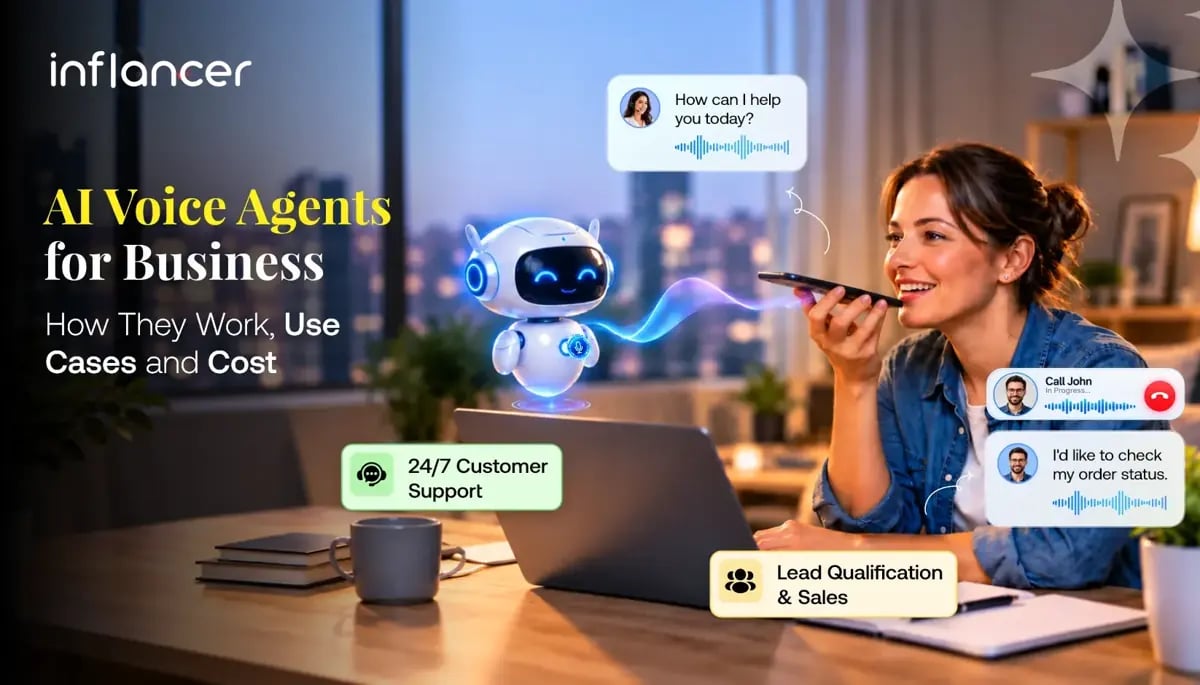
AI voice agents are software systems that can speak with callers, understand what they say, respond in real time, and complete predefined business tasks during a phone conversation. Unlike basic automated menus, modern AI-powered voice agents can maintain conversational context and connect with external tools or business systems to retrieve information or take approved actions.
For businesses exploring AI voicebot development, this means repetitive phone workflows such as answering common questions, qualifying leads, scheduling appointments, checking order information, or routing callers can be automated while human teams remain available for conversations that require judgment or escalation.
Key Takeaways
- AI voice agents combine voice interaction, AI reasoning, business rules, and system integrations to handle phone conversations.
- They can support both inbound and outbound calling workflows, depending on the telephony setup and business use case.
- A custom AI voice agent can connect with CRM, scheduling, support, and other business systems through APIs or tools, subject to permissions and integration design.
What Are AI Voice Agents and How Do They Work?
AI voice agents are conversational software applications designed to interact with people through spoken language. They listen to a caller, interpret the request, determine an appropriate response or action, and reply by voice while maintaining the context of the conversation.
Modern voice-agent architectures can work in different ways. A system may use a speech-to-speech model that processes audio directly or a chained architecture that moves through speech-to-text, an AI workflow, and text-to-speech. More advanced implementations combine these capabilities with AI agent development to let voice agents use tools, follow workflows, and complete defined business tasks.
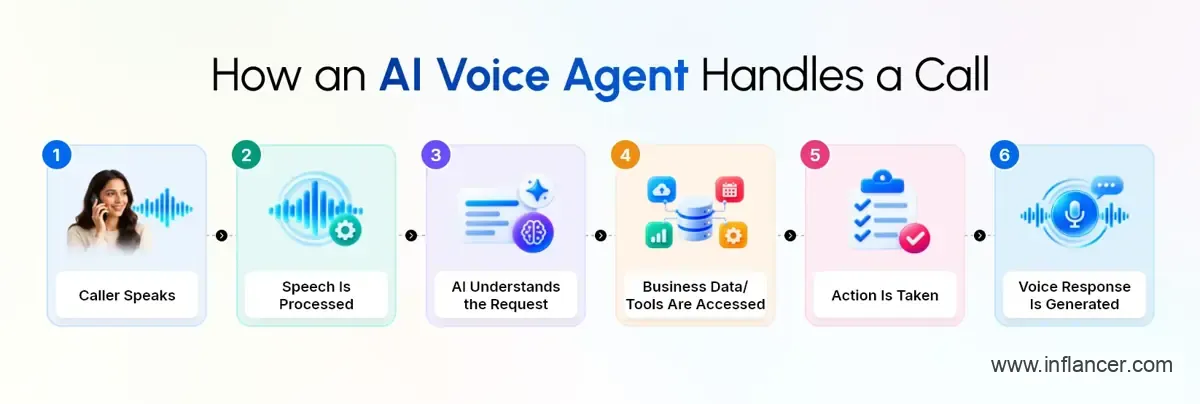
A typical AI phone agent works through five stages:
- Receive speech: The caller speaks naturally over the phone.
- Understand intent: The system processes the audio or transcript and determines what the caller wants.
- Use context: The AI follows conversation instructions, business rules, and available context.
- Take action: When permitted, the agent can call tools or connected systems to retrieve information or complete a task.
- Respond by voice: The system generates a spoken response and continues the conversation.
OpenAI’s Realtime systems, for example, support live audio conversations, conversation state, tool use, interruptions, and handoffs. Twilio’s Conversation Relay provides another architecture in which live speech is transcribed, sent to an AI application, and converted back into speech for the caller.
AI Voice Agent vs. Basic Call Automation
The important difference is not simply that both systems can speak to callers. It is how the conversation is handled.
| Capability | Traditional Call Automation | AI Voice Agent |
|---|---|---|
| Interaction | Menu or rule driven | Conversational |
| Caller input | Often keypad or fixed phrases | Natural spoken requests |
| Responses | Predetermined | Context-dependent |
| Conversation context | Limited | Can maintain session context |
| Business actions | Preconfigured flows | Can use tools and APIs |
| Interruptions | Often limited | Supported by some real-time architectures |
| Best suited for | Simple routing | Multi-step conversational workflows |
The exact capabilities depend on the platform and implementation. An AI voice agent should therefore be evaluated by what it can reliably understand and complete, not simply by whether it sounds natural.
How Can AI Voice Agents Automate Business Phone Calls?
AI voice agents automate business phone calls by connecting conversational AI with telephony, business logic, and the systems needed to complete a caller’s request. Instead of only answering the phone, an AI calling agent can interpret the conversation and trigger an approved workflow.
For inbound calls, AI voice automation can support tasks such as:
- Answering common customer questions
- Scheduling or changing appointments
- Collecting initial customer information
- Checking an order or request status
- Qualifying incoming leads
- Routing calls to the correct team
- Escalating complex cases to a person
For outbound calls, businesses can design agents for:
- Appointment reminders
- Lead qualification
- Customer follow-ups
- Service notifications
- Feedback collection
- Confirmation calls
For outbound calls, AI voice agents can handle follow-ups, appointment reminders, lead qualification, and customer notifications. On inbound calls, they can answer routine questions, schedule appointments, support self-service requests, and route conversations when human assistance is needed.
Where Automation Ends
An automated phone call AI system should not be designed to handle every conversation without limits. Workflows involving sensitive decisions, unusual requests, required approvals, or situations outside the agent’s defined scope should have clear escalation or human-handoff paths.
OpenAI’s voice-agent guidance specifically includes guardrails and human review among the core building blocks to consider when spoken workflows require safety checks or approvals.
What Can an AI Voice Agent Do for a Business?
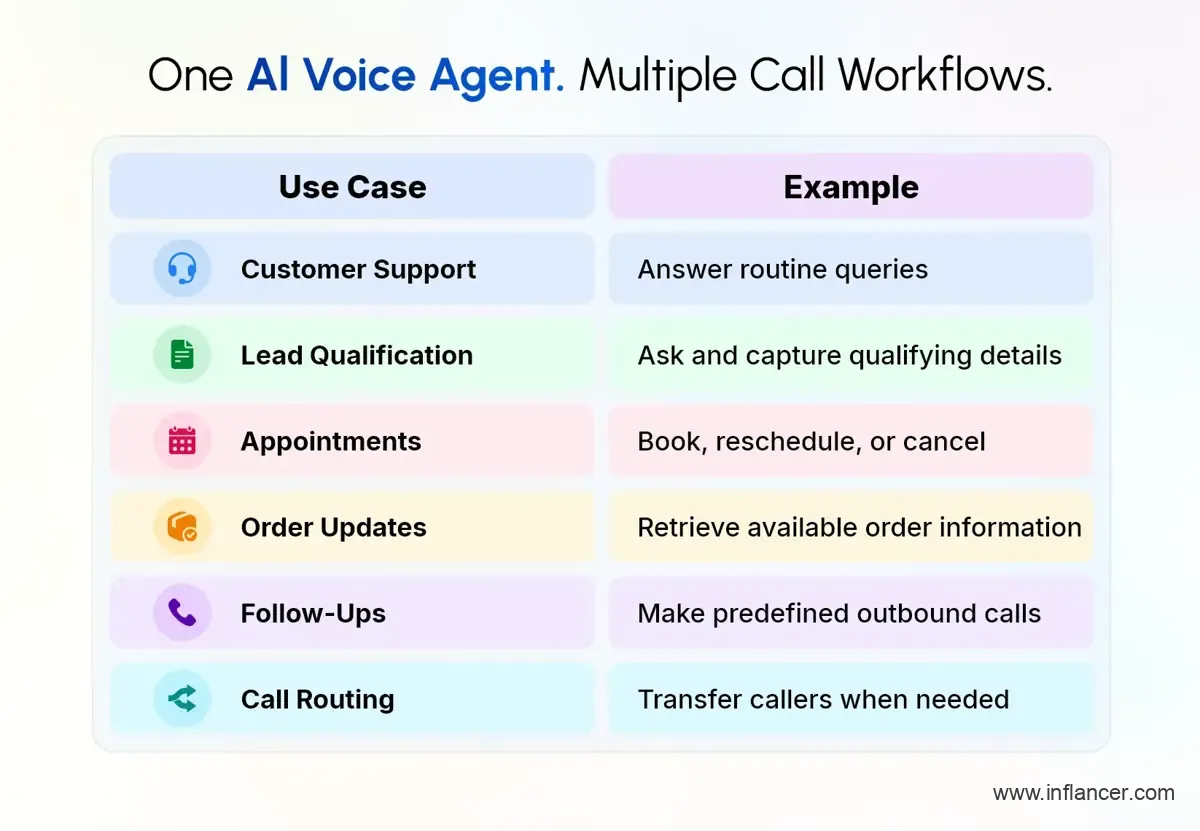
An AI voice agent for business can automate repeatable conversations while connecting the call with the information and workflows behind it. Its practical value depends on what systems it can access, what actions it is authorized to perform, and how well the workflow is designed.
1. Customer Support
Conversational AI voice agents can answer routine questions, retrieve relevant information, capture request details, and route unresolved issues to human support teams.
For example, a caller asking about an order could provide identifying information, have the agent query an approved backend system, and receive the returned status during the conversation.
2. Sales and Lead Qualification
An AI calling agent can ask predefined qualification questions, capture lead information, identify customer requirements, and route qualified opportunities to the sales team.
Businesses can extend this approach through conversational AI for sales and marketing to automate suitable customer interactions across different stages of the sales journey.
3. Appointment Management
AI phone agents can support appointment booking, confirmations, rescheduling, and reminders when integrated with an appropriate scheduling system.
A caller could say, “Can I move my appointment to Friday afternoon?” The agent can interpret the request, check available options through a connected scheduling tool, confirm the caller’s selection, and update the system if the integration permits it.
4. Operations
Voice agents can also be designed for operational workflows such as request intake, status checks, confirmations, employee support, or information collection.
The workflow should determine exactly what the agent can read, write, approve, or escalate.
AI Voice Agents vs. Human Agents: Where Should Each Be Used?
AI voice agents are best suited to repeatable, well-defined conversations, while human agents remain important for situations requiring judgment, negotiation, empathy, exception handling, or complex decision-making.
| Use Case | AI Voice Agent | Human Agent |
|---|---|---|
| FAQs | Strong fit | Usually unnecessary |
| Appointment reminders | Strong fit | Usually unnecessary |
| Basic lead qualification | Strong fit | Useful after qualification |
| Routine status checks | Strong fit | Escalation when needed |
| Complex complaints | Support role | Strong fit |
| Negotiations | Limited | Strong fit |
| Unusual exceptions | Escalate | Strong fit |
| Sensitive decisions | Requires careful controls | Often necessary |
A practical strategy is therefore automation plus escalation, rather than assuming every phone conversation should become fully autonomous.
Can AI Voice Agents Integrate with CRM and Business Systems?
Yes. AI voice agents can integrate with CRM platforms and other business systems when those systems provide suitable APIs, tools, connectors, or integration interfaces. Businesses can also use ChatGPT integration services where an OpenAI-powered conversational layer needs to connect with existing applications, workflows, or enterprise data.
Depending on the business environment, an AI voice agent could connect with CRM systems, help desks, appointment calendars, order management platforms, ERP applications, knowledge bases, ticketing systems, and internal APIs.
Depending on the business environment, an AI voice agent could be connected to:
- CRM systems
- Help desk platforms
- Appointment calendars
- Order management systems
- Customer databases
- ERP applications
- Knowledge bases
- Ticketing systems
- Internal APIs
Consider a sales call. A caller expresses interest in a service, the AI agent collects the required information, and an approved CRM integration creates or updates the lead. If the lead meets predefined criteria, the workflow can route the conversation or create a follow-up task.
What Makes AI Voice Agents Different from Voice Bots?
The term “voice bot” can refer broadly to software that responds to spoken input, while an AI voice agent usually implies a system capable of maintaining conversational context and performing tasks through tools or business workflows.
The distinction becomes clearer when the caller moves beyond a simple question.
A basic voice bot might answer:
“Our office opens at 9 AM.”
A task-oriented AI voice agent could instead understand:
“I can’t make my 9 AM appointment. Do you have anything later?”
It could then use an authorized scheduling tool to check availability, discuss options, and submit the selected change.
That ability to connect conversation with action is one of the most important characteristics of agentic voice automation.
What Technologies Are Used to Build AI Voice Agents?
AI voice agent development typically combines telephony, audio processing, an AI model or agent workflow, business logic, integrations, and monitoring. The exact architecture depends on the required latency, control, compliance needs, and use case.
Two common architectures are:
- Speech-to-speech architecture: Audio is processed directly by a realtime model that handles the conversation and generates spoken responses. OpenAI’s Realtime API is an example of an architecture where speech, reasoning, and tool use can operate within one session.
- Chained architecture: Speech is converted into text, passed through an AI workflow, and then converted back into speech. This provides more control over the individual speech recognition, reasoning, and speech-generation stages.
The intelligence layer determines how the agent understands requests, maintains context, generates responses, and decides what action to take. Businesses building more specialized conversational systems may use custom LLM development services to align the language model layer with specific workflows and knowledge requirements.
For enterprise use cases, conversational AI for enterprises can connect natural voice interactions with customer support, sales, operations, and internal business workflows.
Depending on the use case, generative AI development can also support dynamic response generation, contextual conversations, knowledge retrieval, and other intelligent capabilities within the voice experience.
A production AI voice agent system may connect telephony, speech processing, AI or LLM capabilities, business logic, and external tools or APIs to understand callers, take actions, and generate voice responses.
Phone connectivity can be implemented through telephony infrastructure such as SIP or an application audio bridge. OpenAI’s current telephony documentation supports both direct SIP connections and server-side audio bridges for voice applications.
How Quickly Can Businesses Start Automating Calls?
A basic AI voice proof of concept can be assembled quickly using existing real-time voice and telephony APIs, but a production-ready business agent requires more than connecting a phone number to an AI model.
The actual development timeline depends on the workflow, integrations, testing, security requirements, languages, call volume, and compliance needs.
Production AI voice agent development typically involves:
- Defining the call objective.
- Mapping conversation paths and exceptions.
- Selecting the voice and AI architecture.
- Connecting telephony.
- Integrating required business systems.
- Defining tools, permissions, and guardrails.
- Adding escalation and human handoff.
- Testing real call scenarios.
- Measuring latency and task completion.
- Monitoring and improving the deployed agent.
Latency deserves particular attention because even a technically correct response can create a poor phone experience if callers wait too long. OpenAI recommends measuring how long callers wait for a useful spoken answer and tracking backend latency separately when evaluating voice agents.
How Much Does It Cost to Develop an AI Voice Agent?
A business should generally plan for $5,000 to $50,000+ for custom AI voice agent development, plus ongoing usage costs that can be around $0.08 to $0.15 per call minute for a typical production stack. The final cost depends heavily on the agent’s complexity and integrations.
For development budgeting, a practical breakdown is:
| AI Voice Agent Scope | Estimated Development Cost* |
|---|---|
| Basic voice agent or PoC | $5,000–$10,000 |
| Business voice agent with integrations | $10,000–$25,000 |
| Advanced multi-workflow agent | $25,000–$50,000+ |
| Enterprise voice AI system | Custom pricing |
What Should Businesses Consider Before Implementing AI Voice Automation?
Businesses should evaluate task suitability, integration requirements, latency, security, escalation, and measurable success criteria before deploying AI voice automation. A natural-sounding voice alone does not make an agent reliable.
1. Clear Scope
Define exactly what the AI phone agent is allowed to do. “Handle customer support” is too broad. “Answer order-status questions and transfer unresolved cases” is much easier to design and evaluate.
2. System Access
Give the agent access only to the systems and actions required for its role. Business logic, permissions, and approval checks should remain controlled by the application.
3. Human Handoff
Define when a conversation should move to a person and ensure the context required for that handoff can be preserved where the implementation supports it.
4. Conversation Testing
Test interruptions, silence, unclear speech, unexpected requests, background noise, incorrect information, and tool failures rather than evaluating only ideal conversations.
Realtime voice systems need specific handling for these conditions. OpenAI, for example, documents voice activity detection and interruption handling, while its prompting guidance discusses explicitly handling silence and background audio.
5. Privacy and Compliance
Businesses should assess recording, consent, data retention, access control, regional telephony requirements, and industry-specific obligations before deployment. Compliance depends on the complete architecture and configuration, not simply the presence of an AI model.
How Can Businesses Build a Custom AI Voice Agent?
Businesses can build a custom AI voice agent by defining one high-value calling workflow first, selecting the appropriate voice architecture, connecting the required business systems, and testing the complete conversation before expanding automation.
Teams starting from the broader agent architecture can first understand how to build AI agents before adding telephony, speech processing, voice responses, and call-specific workflows.
For organizations that need dedicated engineering expertise, another option is to hire AI agent developers to build and integrate the required conversational workflows.
A practical AI voice agent development process is:
- Choose the use case: Start with a specific workflow such as lead qualification, appointment scheduling, support triage, or order-status calls.
- Map conversations: Document expected requests, required information, exceptions, escalation conditions, and successful outcomes.
- Select the architecture: Choose between realtime speech-to-speech and a chained voice pipeline based on latency, control, observability, and integration requirements.
- Connect telephony: Integrate phone infrastructure through an appropriate SIP, programmable voice, or audio-bridge setup.
- Add business tools: Connect the CRM, scheduling platform, knowledge source, ERP, or other systems required to complete the workflow.
- Apply guardrails: Set permissions, confirmation requirements, escalation rules, and boundaries for what the agent can do.
- Test real conversations: Evaluate task completion, response accuracy, interruptions, tool calls, latency, and failure scenarios.
- Deploy and measure: Monitor the agent against defined business outcomes and improve the workflow based on actual call performance.
For businesses without an internal AI engineering team, working with an AI voice agent development company can help bring telephony, conversational AI, backend integrations, testing, security, and deployment into one implementation plan.
Need an AI Voice Agent Built for Your Workflows?
Turn your call processes into intelligent voice experiences designed around your customers, teams, and existing systems.
Why Custom AI Voice Agent Development Matters?
Custom AI voice agent development allows the calling workflow to reflect the business’s actual processes rather than forcing every conversation through a generic script.
A custom solution can define:
- What the agent knows
- What systems it can access
- What actions it can perform
- When confirmation is required
- When a human should take over
- What information should be recorded
- How different call scenarios should be handled
This becomes especially important when AI-powered voice agents need to work across existing CRM, scheduling, support, or operational systems.
The objective should not be to make the agent talk for as long as possible. It should be to help the caller complete the intended task accurately, safely, and with minimal friction.
Why Businesses Choose Inflancer for AI Voice Agent Development
Inflancer helps businesses build custom AI voice agents around real calling workflows, business systems, and customer needs. From strategy and conversation design to development, integration, testing, and deployment, the focus stays on creating voice automation that can perform useful business tasks, not simply answer calls.
- Custom Voice Agents: Build AI voice agents for specific inbound, outbound, support, sales, scheduling, and operational workflows.
- Business Integrations: Connect voice agents with CRM platforms, APIs, databases, calendars, and other business systems.
- AI Expertise: Combine conversational AI, LLMs, generative AI, and automation technologies to build context-aware voice experiences.
- End-to-End Development: Cover planning, architecture, development, integration, testing, deployment, and ongoing optimization within one development engagement.
- Scalable Architecture: Design voice solutions that can support growing call volumes, new workflows, additional integrations, and evolving business requirements.
- Human Handoff: Create escalation paths that transfer conversations to human teams when a request needs judgment or additional support.
Together, these capabilities help businesses move from basic call automation to AI voice agents that can understand conversations, take action, and work within existing business processes. Inflancer builds each solution around the workflows, integrations, and outcomes the business actually needs.
The Future of Business Calls Is Conversational and Action-Oriented
AI voice agents are moving phone automation beyond keypad menus and fixed scripts. They can understand spoken requests, maintain conversational context, access approved tools, and help complete business workflows during a live call. Current voice-agent platforms already support real-time conversations, tool use, telephony connectivity, interruptions, and configurable handoffs.
For businesses, the strongest starting point is a clearly defined, repetitive phone workflow with a measurable outcome. Build the agent around that task, connect only the systems it needs, provide a human escalation path, and expand automation after the workflow performs reliably.
Build Next-Gen AI Voice Agents Around Your Business
Turn repetitive phone conversations into connected AI workflows. Build custom AI voice agents for support, sales, scheduling, operations, and other business calling needs.
Frequently Asked Questions
Get the weekly updates on the newest brand stories, business models and technology right in your inbox.